

Roy Morgan Research (RMR) last night released its unemployment estimate for the month of September, which registered a large rise in the unemployment rate to 9.9% from 8.7% in August (see next chart).
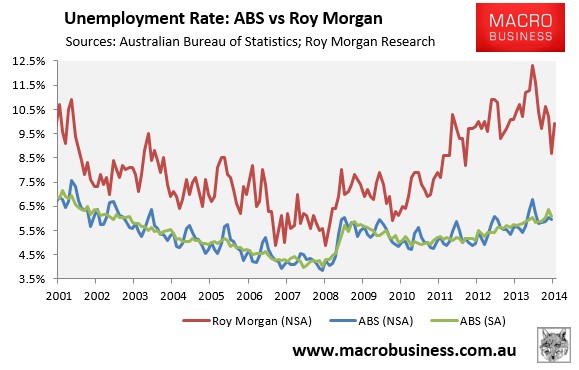
The rise in the unemployment rate was driven by a large contraction in the number of full-time workers, which are at their lowest level since October 2011 and have barely risen over the past seven years, despite the 2.5 million increase in Australia’s population.
According to Gary Morgan:
“Driving the rise in unemployment was a large fall in Australia’s full-time employment (7,168,000, down 279,000) – now at its lowest in nearly three years since October 2011 (7,131,000). The fall in full-time employment was only partially offset by a rise in part-time employment (3,848,000, up 154,000). Despite the rise in part-time employment, Australian under-employment fell to 1.015 million (down 65,000 – 8.3%, down 0.5%).
“The Roy Morgan September employment estimates clearly indicate the increasing casualisation of the Australian workforce as part-time employment increases at the expense of full-time employment. Analysing employment trends over a longer-time period shows this even more starkly.
“In November 2007 when Kevin Rudd was elected Prime Minister Australian full-time employment was 7,155,000 (70.7% of employed Australians) and part-time employment was 2,970,000 (29.3%). Since November 2007 full-time employment has increased 13,000 to 7,168,000 (65.1% of employed Australians) and part-time employment has increased 878,000 to 3,848,000 (34.9%). The ABS shows that Australia’s population was 21 million in mid-2007, latest estimates show an Australian population of 23.6 million today – an increase of over 2.5 million Australians – but only 13,000 new full-time jobs.
“That is a shift of over 5% of employed Australians from full-time work to part-time work. This large change in the composition of the Australian workforce also underlines why it is a mistake to concentrate only on the unemployment estimates (which are understated on a monthly basis by the ABS). The increasing level of under-employment in Australia is woefully ignored.
“The overall picture of the Australian labour market shows an economy with a large amount of under-utilised labour – now 2.22 million Australians (18.2%) are either unemployed or under-employed. This is the 34th straight month more than 2 million Australians have been looking for work or looking for more work and the 28th straight month more than 1 million Australians have been unemployed.”
As explained previously, RMR measures employment differently from the ABS:
According to the ABS definition, a person who has worked for one hour or more for payment or someone who has worked without pay in a family business, is considered employed regardless of whether they consider themselves employed or not.
The ABS definition also details that if a respondent is not actively looking for work (ie: applying for work, answering job advertisements, being registered with Centre-link or tendering for work), they are not considered to be unemployed.
The Roy Morgan survey, in contrast, defines any respondent who is not employed full or part-time and who is looking for paid employment as being unemployed…
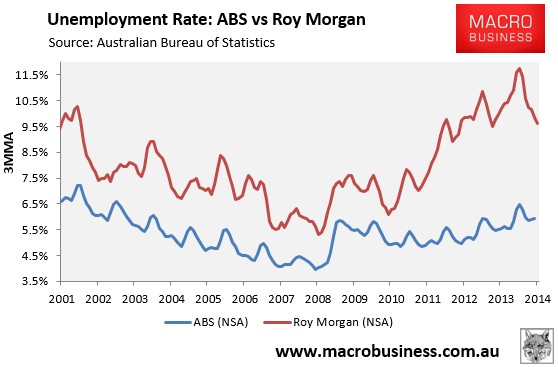
Since Roy Morgan uses a broader definition of unemployment than the ABS, it necessarily reports a higher unemployment figure. In addition, Roy Morgan’s measure tends to be far more volatile, owing to the fact that it draws on a smaller sample than the ABS and is not seasonally adjusted.
The difference between the official ABS unemployment rate (6.1%) and the unofficial RMR measure is now 3.8% (see next chart).
The ABS will release its labour force survey for September next week, which will provide more colour on the state of the Australian jobs market.
unconventionaleconomist@hotmail.com
