Headwinds — In the quite sharp sell-off in the past month (~9% at yesterday’s close), the Australian market has been buffeted from a few quarters: rising bond yields, potentially the start of some competition to higher-yielding equities; falling commodity prices, putting more pressure on resource earnings, and weak China IP growth and the property downturn there arguably adding some wider concerns about the economy and earnings in Australia; and the fall in the AUD, with likelycapital outflows in the short term, even though supportive of the market over time.
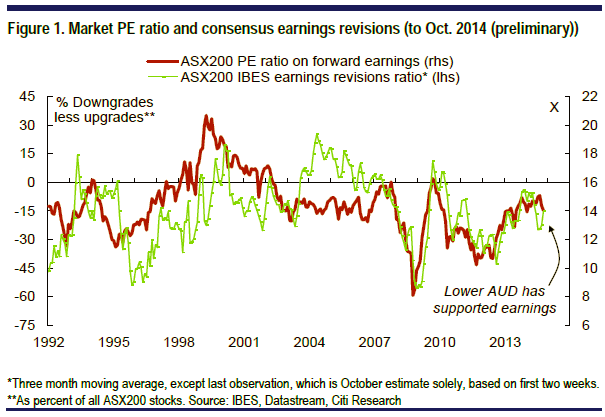
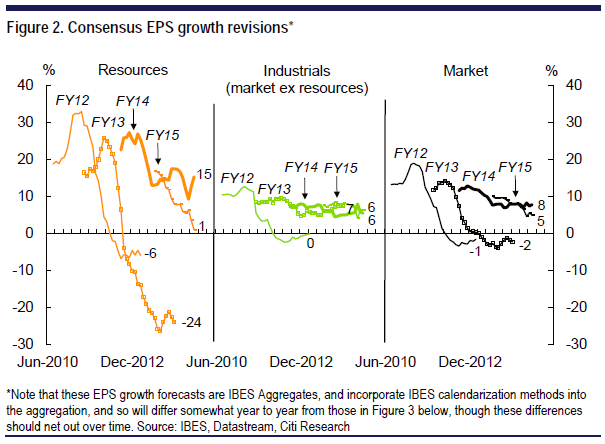
Overdue? — Prior to the sell-off, the market had been trading at a fairly full PE, touching 15.1x consensus earnings, its highest multiple in nearly five years, and despite steady downgrading of market earnings growth over the prior few months. So with further threats to earnings, some de-rating isn’t surprising (Figure 1); but, equally, market earnings already look to be proving fairly resilient, with downgrades lessening through the past month, as commodity prices and the AUD have tended to net out for resources, and the AUD has driven upgrades for offshore industrials.
Gains again? — The de-rating has left the market trading on 14.0x, a bit below its medium-term average, and bond yields have now fully retraced their rise, ~½% for Australia’s 10-year yield. Of course, this reflects some concerns again about growth globally, and so leaves uncertainties around earnings; but at this stage, our sense, and that of Citi’s economists, is that there don’t seem inordinate downside risks, and so we could see earnings downgrades abate more. And hence, while the Australian market could stay volatile if the AUD declines further, it could recover a bit as well.
Sigh. I don’t think so. Those 2015 consensus resources earnings estimates are based upon an iron ore price of about $90. As UBS noted yesterday, at current spot prices BHP and RIO will be looking at roughly 25% lower earnings between them. Add FMG and the juniors and it’s more like 30%. That’s most of the sector and a big chunk of the market even before we start talking about multiplier effects through other segments.
In short, iron ore alone is going to lay waste to consensus earnings and the de-rating continue even if international bourses stabilise.
David Llewellyn-Smith is Chief Strategist at the MB Fund and MB Super. David is the founding publisher and editor of MacroBusiness and was the founding publisher and global economy editor of The Diplomat, the Asia Pacific's leading geo-politics and economics portal.
He is also a former gold trader and economic commentator at The Sydney Morning Herald, The Age, the ABC and Business Spectator. He is the co-author of The Great Crash of 2008 with Ross Garnaut and was the editor of the second Garnaut Climate Change Review.