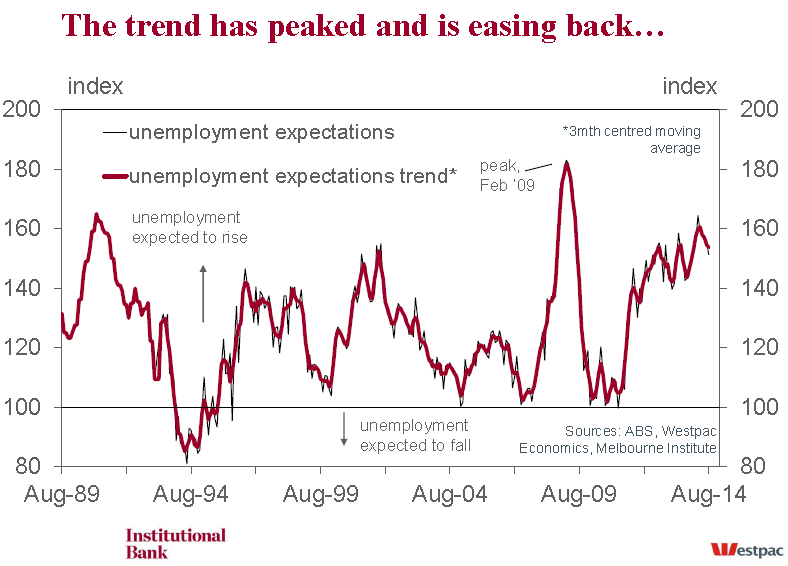
The Westpac-Melbourne Institute Unemployment Expectations Index declined 3% in Aug following declines of 0.3% in Jul, and 1.1% in Jun. Recall that lower reads indicate reduced concern around the labour market.
This is the fifth consecutive decline taking the index 7.9% below its Mar peak. The index appears to have peaked with a trend decline now evident now over the past four months. However, the index is coming from a very high starting point and still only down slightly (–0.9%) on its level a year ago. This suggests households believe we have passed the worst for the labour market but that conditions are still not particularly robust
Note that we saw similar apparent trend peaks in 2012 and 2013 that ultimately proved to be false, or unsustained, turning points. The difference this time around is that business surveys are showing a more substantive improvement suggesting a genuine turning point.
The trend will not have peaked for me until it falls below the last dip, some distance below. Full report here.
Meanwhile, from the Melbourne Institute:
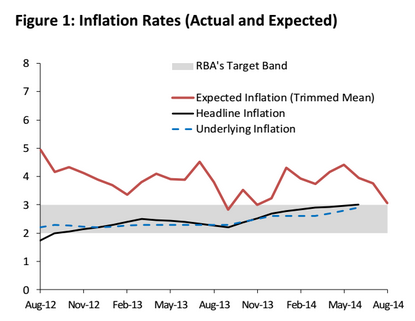
The Melbourne Institute consumer expected inflation rate (30-per-cent trimmed mean measure) fell considerably in August, by 0.7 percentage points to 3.1 per cent from 3.8 per cent in July. The underlying distribution of responses in Table 2 shows a sharp drop in the proportion of responses around expected price change of 10 per cent and rises in the clusters of responses around expected price changes of 1, 2 and 5 per cent.
David Llewellyn-Smith is Chief Strategist at the MB Fund and MB Super. David is the founding publisher and editor of MacroBusiness and was the founding publisher and global economy editor of The Diplomat, the Asia Pacific’s leading geo-politics and economics portal.
He is also a former gold trader and economic commentator at The Sydney Morning Herald, The Age, the ABC and Business Spectator. He is the co-author of The Great Crash of 2008 with Ross Garnaut and was the editor of the second Garnaut Climate Change Review.