
Roy Morgan Research (RMR) last night released its unemployment estimate for the month of June, which registered a large rise in the unemployment rate to 10.6% from 9.7% in May (see next chart).
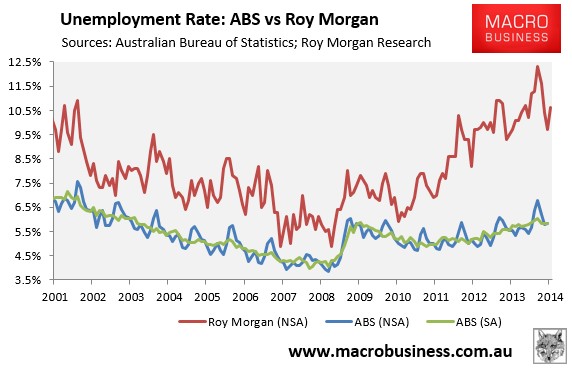
The rise appears to have been driven largely by seasonality, with RMR registering an increase in the unemployment rate in June in each of the last four years, and also in five out of the last six years. Importantly, however, the measure remains higher year over year suggesting more upwards pressure on the ABS figures.
Under-employment has risen to 9.5%, which is the highest level ever recorded by RMR. In June, a total estimated 2.514 million Australians (20.1% of the workforce) were either unemployed or under-employed. This is up 2.3% from May and up 1.2% higher than in June 2013.
As explained previously, RMR measures employment differently from the ABS:
According to the ABS definition, a person who has worked for one hour or more for payment or someone who has worked without pay in a family business, is considered employed regardless of whether they consider themselves employed or not.
The ABS definition also details that if a respondent is not actively looking for work (ie: applying for work, answering job advertisements, being registered with Centre-link or tendering for work), they are not considered to be unemployed.
The Roy Morgan survey, in contrast, defines any respondent who is not employed full or part-time and who is looking for paid employment as being unemployed…
Since Roy Morgan uses a broader definition of unemployment than the ABS, it necessarily reports a higher unemployment figure. In addition, Roy Morgan’s measure tends to be far more volatile, owing to the fact that it draws on a smaller sample than the ABS and is not seasonally adjusted.
Nevertheless, the official ABS unemployment rate and the unofficial RMR measure tracked each other closely until mid-2010 before diverging sharply (see next chart).
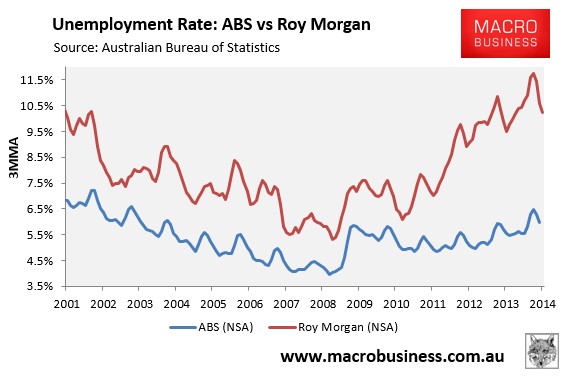
As always, the reasons behind the big divergence between the RMR and ABS unemployment measures since mid-2010 remain a mystery, but probably has something to do with RMR’s picking-up discouraged workers.
On Tuesday, the ABS will release its labour force survey for June, which will provide more colour on the Australian jobs market.