

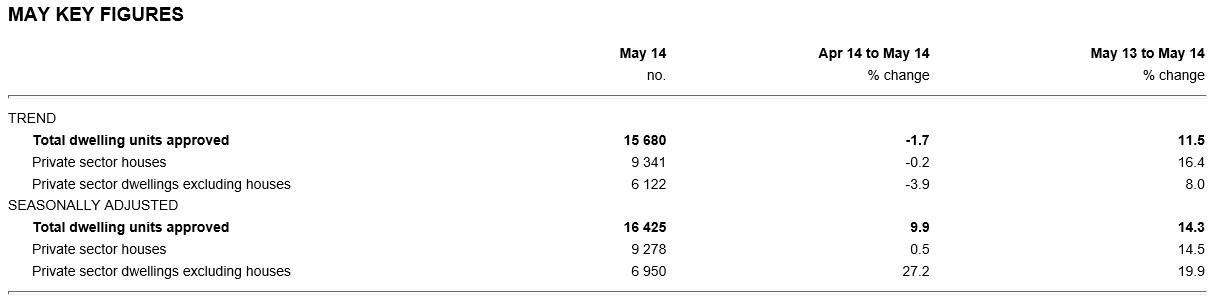
The Australian Bureau of Statistics (ABS) has released dwelling approvals data for the month of May. At the national level, the number of dwelling approvals rose by a seasonally adjusted 9.9% to 16,425. The overall rise was driven by the volatile unit and apartment segment, which rocketed by 27.2%, whereas house approvals rose only modestly (0.5%). The result beat analysts’ expectations, who had expected a 3.2% lift in approvals over the month.
In the year to May 2014, dwelling approvals rose by a seasonally-adjusted 14.3%, with house approvals up by 14.5% and unit approvals up by 19.9%:
A chart showing the time series of seasonally-adjusted dwelling approvals at the national level is provided below, split-out by detached houses and units & apartments:
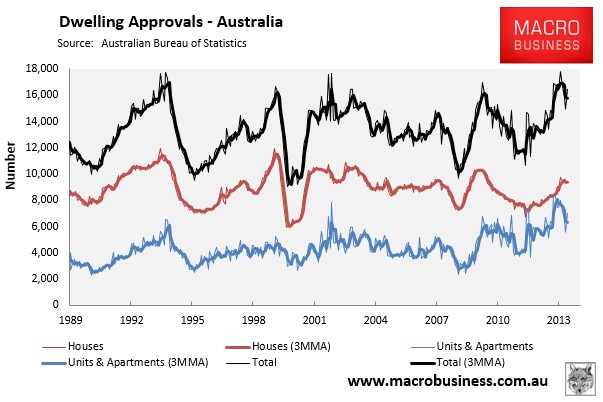
As you can see, after trending-up strongly since late-2011, dwelling approvals nationally appear to have topped-out, despite this month’s rise. While house approvals continue to improve (albeit remain lackluster overall), unit & apartment approvals are retracing from recent record highs.
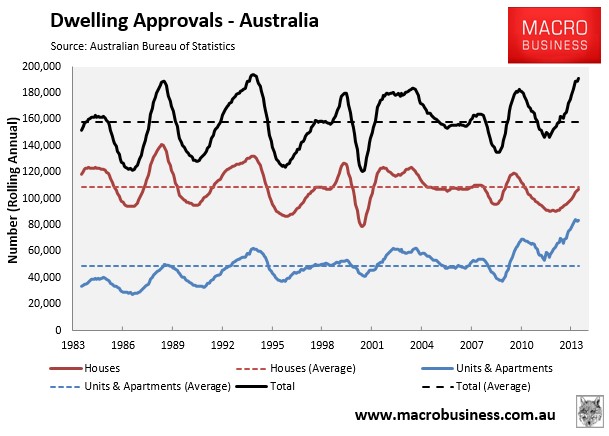
In annual terms, dwelling approvals are running near record highs, as shown by the below chart, with relative weakness in detached house approvals more than offset by strength in unit & apartment approvals. However, as noted previously, approvals remain fairly depressed overall in population-adjusted terms, given that Australia’s population has grown by around 45% over the past 30-years. Approvals also appear to be topping-out when measured in annual terms:
The below chart shows the time-series of approvals at the state level:
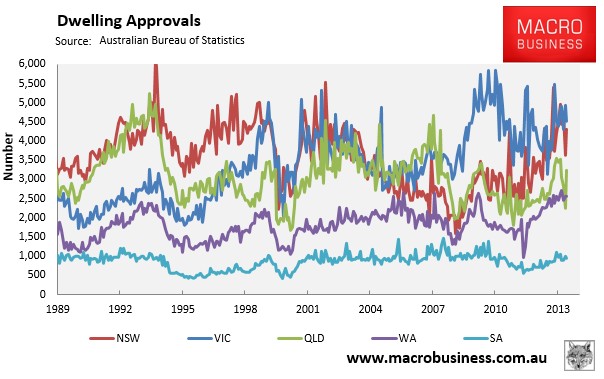
This month’s surge in approvals was driven by New South Wales (+19%) and Queensland (+20%), whereas Victoria (+45%), which registered a very large increase in apartment approvals (+47% and +150% respectively).
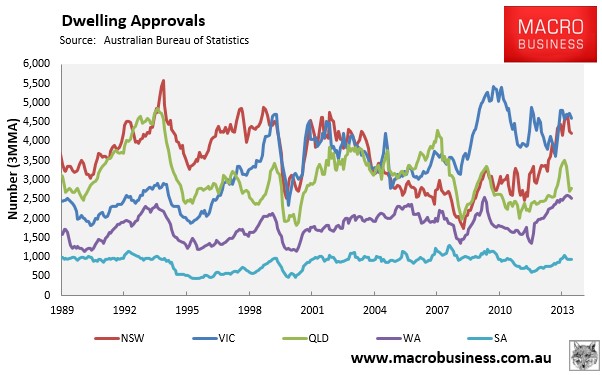
The same data is shown below on a three-month moving average basis, in order to smooth volatility. As you can see, dwelling approvals remain in weakening uptrends in New South Wales, Western Australia, and Queensland, are range-bound and tracking sideways in Victoria, and appear to have corrected in Queensland:
The next few month’s data will be vital as it will confirm whether the mini construction boom is ongoing or running out of gas, pointing to a potential weakening of housing construction activity in 2015 just as the mining investment cliff intensifies.
