The NSW budget is out today and is basking in the glow of property. Here is the revenue statement:
Total revenue in 2013-14 is estimated at $65.4 billion. This is 8.8 per cent higher than the 2012-13 outcome, and around $2.9 billion more than was anticipated in the 2013-14 Budget.
Total revenue in 2014-15 is estimated at $67.1 billion, 2.6 per cent higher than the expected 2013-14 outcome. Total revenue growth from 2015-16 is projected to average 3.8 per cent over the forward estimates.
The growth pattern in aggregate revenue masks significant divergences in individual revenue components.
A stronger than expected resurgence in the property market has significantly lifted transfer duties in 2013-14 and across the forward estimates. Prospects of a strengthening NSW economy and stronger labour market should also contribute to state taxes overall growing by an average 5.3 per cent across the budget and forward estimates period.
Changes to revenues expected under federal state funding agreements announced by the Commonwealth in its 2014-15 Budget have material impacts on total revenue growth rates across the budget and forward estimates. The changes affect both the quantum and timing of Commonwealth funding to New South Wales. They include a substantial re-profiling of existing funding, mainly transport, of around $800 million into 2013-14, predominantly from 2014-15.
These aggregate revenue growth variations highlight the vulnerability of state revenue bases to the volatility and uncertainty caused by unilateral actions of the Commonwealth. When unexpected and late, they further compound the challenges facing state governments in ensuring sustainable service delivery.
Forthcoming White Papers on Federation and Taxation should agree a clear set of roles, responsibilities and commensurate taxation arrangements for each level of government. To do so, they must be developed in a truly collaborative manner.
New South Wales will take a principled leadership approach and work to negotiate outcomes that include a fairer share of GST revenue and access to other Commonwealth tax bases. As a sign of good faith to these upcoming discussions, and despite continuing revenue risks, the Government will remove remaining Intergovernmental Agreement Taxes from 1 July 2016.
The Government continues to support First Home Owners by increasing the grant cap to homes valued at up to $750,000 from 1 July 2014.
Consistent with regulatory and private sector best practice, the Government will ensure that dividends paid will not impact on customer prices or service quality.
A nice slap there for the “volatile and uncertain” Tony Abbott too.
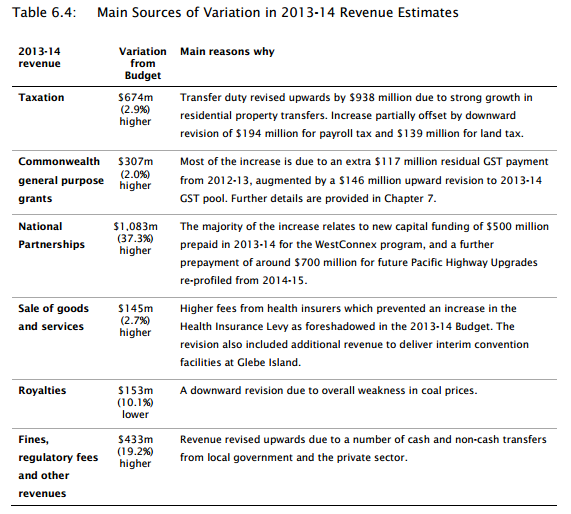
Here are the revenue variations:
Advertisement
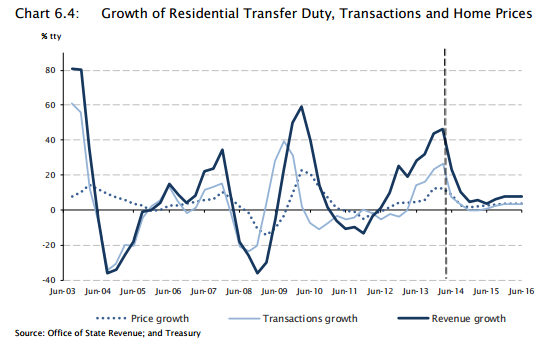
Almost $1 billion to the good on beating what were aggressive stamp duty forecasts. And for the future? More of the same, but easing:
The transfer duty growth cycle appears to have peaked in 2013-14 leading to slower growth in transfer duty over 2014-15 as rising prices limit housing affordability.
This cycle is unusual in that interest rates have remained at historic lows throughout the upswing.
In previous cycles interest rates would have begun to increase by this point, eroding housing affordability and consumer confidence. As a result, the slowdown in this housing cycle is expected to be gentler than in previous cycles.
That chart looks more like boom and bust but to make sure the cap on the FHB grant was lifted to a preposterous $750k. Who knows?
David Llewellyn-Smith is Chief Strategist at the MB Fund and MB Super. David is the founding publisher and editor of MacroBusiness and was the founding publisher and global economy editor of The Diplomat, the Asia Pacific’s leading geo-politics and economics portal.
He is also a former gold trader and economic commentator at The Sydney Morning Herald, The Age, the ABC and Business Spectator. He is the co-author of The Great Crash of 2008 with Ross Garnaut and was the editor of the second Garnaut Climate Change Review.