
While I was away on leave last week, the ABS released its Australian demographic statistics for the December quarter of 2013, which revealed that Australia’s population growth rate continues to fall, driven by declining growth in the two key mining states of Western Australia and Queensland.
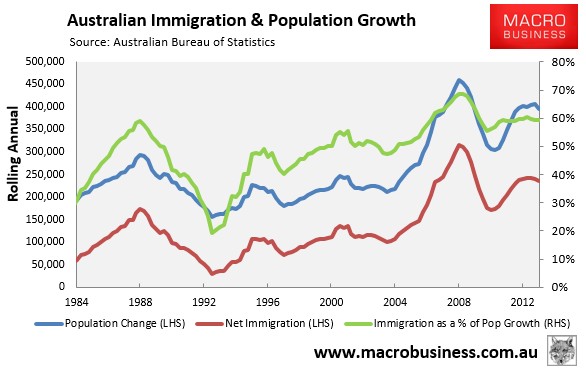
According to the ABS, Australia’s population grew by 1.73% in the year to December 2013 – the fourth consecutive quarterly decline in growth – albeit population growth remained well above the 30-year average of 1.4%.
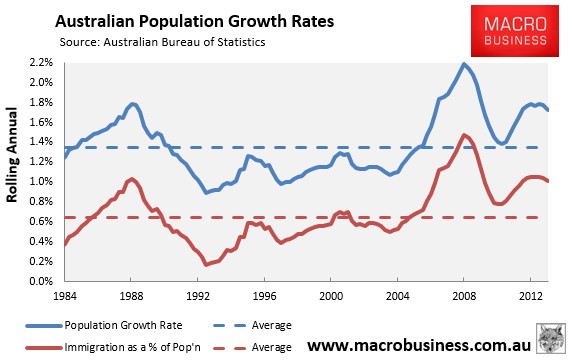
The growth in the number of persons in the year to December 2013 was 396,200, which was still 139,211 above the 30-year average:
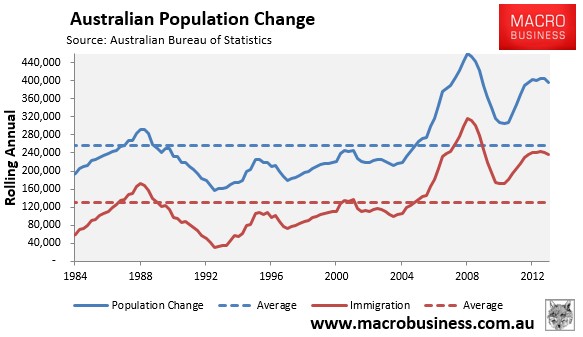
Australia’s population growth continues to be driven by net overseas migration (NOM) – defined as those residing in Australia for 12 months or more (see next chart).
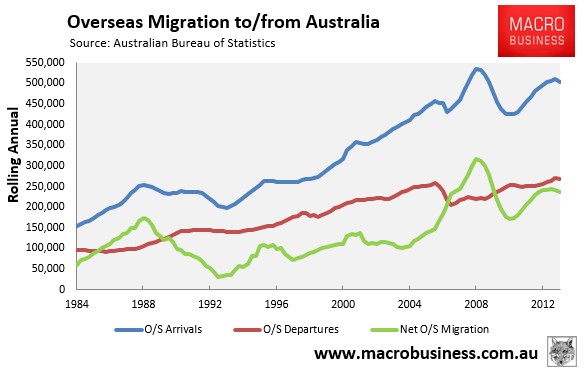
While NOM has declined from a peak of 315,700 in calendar year 2008 to 235,800 in the year to December 2013 – it remains well above the average level of 130,372.
Moreover, as shown below, the proportion of population growth derived from NOM – 60% in the year to December 2013 – remains well above the 30-year average of 48%.
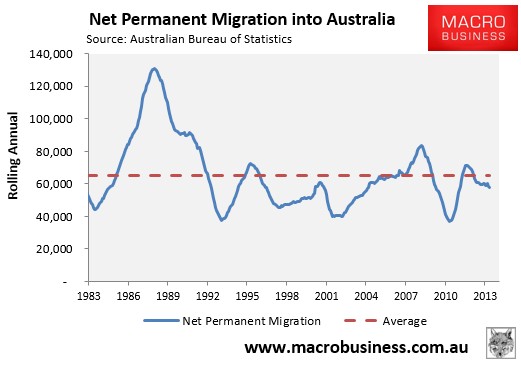
Separate data compiled by the ABS, which measures permanent arrivals/departures into Australia only, suggests that nearly two-thirds of NOM is temporary, although a proportion of these arrivals do become permanent residents at a later date.
As shown in the next chart, the number of net permanent arrivals into Australia was 57,810 in the 12 months to April 2014, which is tracking 11% below the 30-year average of 65,218 (see next chart).
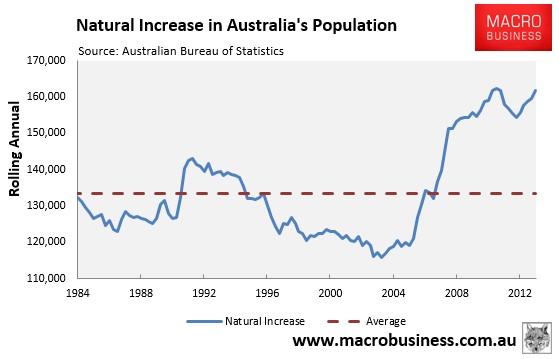
While natural increase – the difference between births and deaths – is not the key driver of Australia’s population growth, it too is running at levels well above the 30-year average (see next chart).
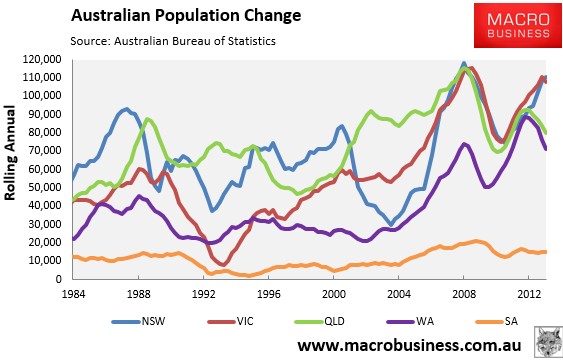
Population growth into Australia’s key resources state – Western Australia – continues to fall, although it remains at a high level overall. In the year to December 2013, Western Australia’s population grew by 2.9% (down from a peak of 3.7%); although it remained well above the national average (1.8%). Population growth in Queensland also fell to 1.7%, which was well down on the 2.1% growth rate recorded in the year to September 2012 (see next chart).
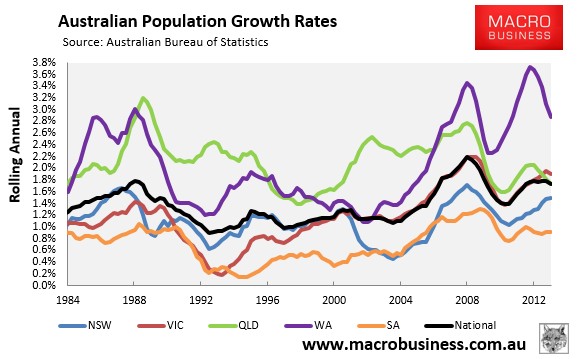
In sheer number terms, New South Wales and Victoria remain the leaders, with their populations growing by a whopping 110,293 and 110,916 respectively in the year to December 2013 (see next chart).
With the mining investment boom unwinding, along with the relatively weak domestic economy, there is the prospect that Australia’s population growth will continue to fall, which is good news for those of us concerned about the nation’s growing infrastructure deficit and overall declining livability.
