

The BRW is running an article on the obscene increase in wealth gained by Australia’s property barons from rising land values:
Billionaire Harry Triguboff has a simple explanation why so many people are getting rich from property.
“I’ve had land that has doubled in value in the past 12 months,” he says…
The total value of property on this year’s BRW Rich List, to be published on Friday, is $16 billion, with 53 of the 200 list members sourcing the majority of their wealth from property…
So, while the tradable sectors of Australia’s economy, those that make our living in the world, are fading owing to high input costs like land. And the Budget is facing an ongoing squeeze from a declining revenue base – namely, shrinking corporate and indirect taxes – along with an excessive (and growing) reliance on personal income taxes, the wealthiest Australians continue to enjoy ever-rising wealth in the form of property holdings, which are largely sheltered from the tax man as well as feted by our short-sighted central bank.
Indeed, rising property (land) values are a key driver of the increasing wealth inequality across the developed world, with those owing large property holdings enjoying gains far in excess of economic growth, particularly over the past 30 years.
An obvious solution, in order to both improve equity and the economy’s productivity, is for Australia’s governments to shift the tax base away from productive effort (e.g. labour) onto immovable items like land and resources.
As noted by the Australian Treasury recently:
Research consistently says that reduced reliance on income taxes and increased reliance on other, more efficient sources of revenue… can support higher growth and higher living standards by increasing workforce participation and lifting productivity.
Indeed, the Henry Tax Review found that personal income taxes have a relatively high “marginal excess burden” (i.e. a large loss in consumer welfare relative to the net gain in government revenue), due in part by their deleterious impact on labour participation (see next chart).
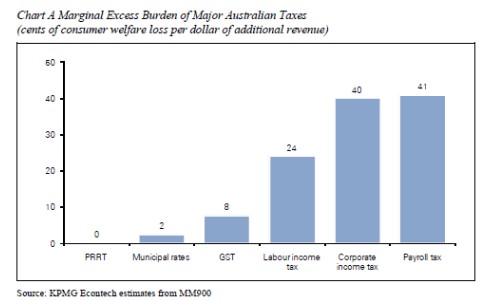
By contrast, a broad-based land tax (along with resource rent taxes) have almost zero efficiency loss (“marginal excess burden”), since they would be applied to a tax base that is completely immobile – land. They are obviously also far more equitable than either consumption taxes or income taxes.
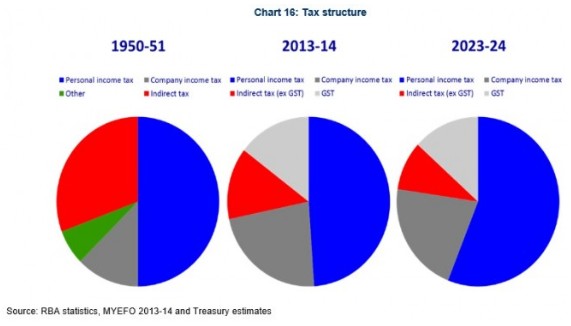
Unfortunately, Australia is moving in the wrong direction, with the proportion of tax revenue raised via inefficient personal income taxes increasing, just as the proportion of workers in the economy is forecast to fall as the population ages (see below charts).
Of course, there are other very good reasons to shift the tax base to broad-based land value taxes (LVT).
As noted previously, a broad-based LVT would also assist in the provision of new housing via two channels. First, an LVT would help make infrastructure investments self-funding for governments, since any land value uplift brought about through increased infrastructure investment (e.g. new roads, trains, etc) would be partly captured by the government via increased LVT receipts. Accordingly, governments would be more likely to facilitate development, rather than act to restrict it in a bid to save on infrastructure costs. Second, an LVT would penalise land banking and vagrancy, effectively increasing the supply of land in the process and bringing new homes to market more quickly.
Put simply, there are sound financial, economic and equity reasons for Australia to pursue a broad-based LVT.
unconventionaleconomist@hotmail.com
