
At Kearney has published a new report measuring foreign direct investment (FDI) confidence across major economies, which shows that confidence in Australia as a destination for FDI has slipped, falling to 8th place in 2014 from 6th place in the previous two years (see below table).
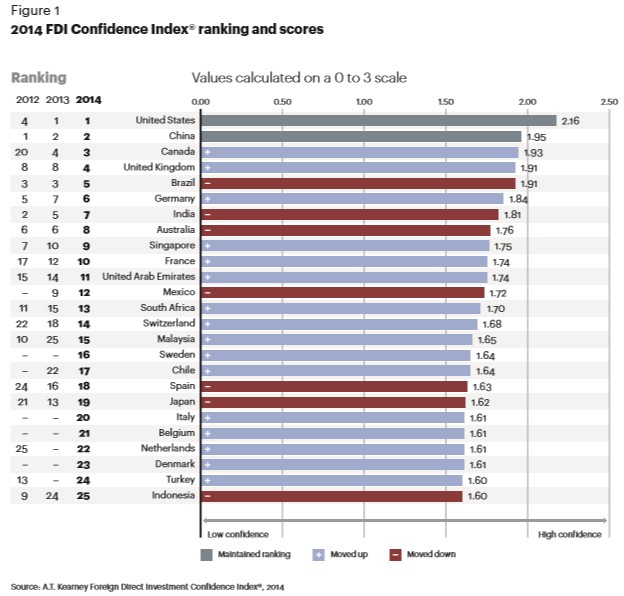
Australia was pushed down the ladder by the United Kingdom and Germany, with the United States and China maintaining first and second position respectively.
Not surprisingly, At Kearney place the blame for Australia’s slide down the rankings on the unwinding commodity boom:
Hurt by the slowdown of the global commodity boom, Australia drops to eighth place but remains in the top 10 for the fourth consecutive edition…
However, curiously the report notes that Australia is shifting its manufacturing base into high technology, which is certainly news to me:
The country is seeking to further diversify beyond commodity-related investment and increasingly propel its manufacturing base into high-technology, innovative products. The country is now home to aerospace and defense giant Boeing’s largest R&D facility outside the United States. Kraft Foods has opened the first stage of Australia’s largest R&D center, in a move aimed at expanding its market to reach the large and expanding Asian consumer base. And to help support industry-led innovation, the Australian government will fund 10 innovation clusters designed to bring more new ideas to market and underpin Australia’s economic ties with the rest of Asia.
While the slip down the rankings is fairly benign, it does highlight one of the risks facing Australia as the once-in-a-century commodity boom unwinds; namely that reduced foreign sentiment and an increase in Australia’s risk premium could make it more difficult (and expensive) for Australia’s banks to roll-over their offshore funding, potentially leading to a liquidity crunch and/or rising costs for borrowers. These pressures would likely be exacerbated by a downgrading of Australia’s sovereign credit rating in the event that commodity prices crash, punching a big hole in the Budget.
unconventionaleconomist@hotmail.com