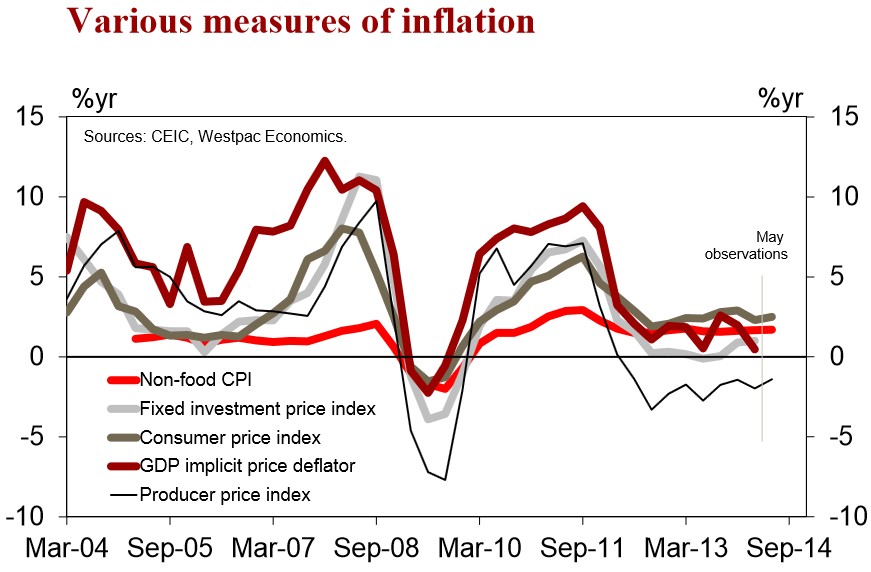
From Westpac’s Huw McKay comes analysis of today’s Chinese inflation data for May, which showed strengthening consumer price inflation (to 2.5% YoY in May, up from 1.8% YoY in April), but producer prices mired in deflationary territory:
The annual rate of consumer price inflation increased by 0.7ppts in May versus April as annual food price gains quickened on the back of a flattering base effect. Non-food prices edged higher, despite a further moderation in the bellwether shelter component.
Food prices rose 0.2% in the month after two second straight m/m declines. A year ago food prices fell quite heavily in May, so that modest gain pushed the annual rate back up to 4.1% (where it was in March) from 2.3% in April.
Non-food prices edged up by 0.1ppts to 1.7%. Upward movements in utilities, fuel for transport, touring costs and apparel offset a move lower in shelter. The most notable development on this latter front was a further deceleration in rental inflation. Rents are down a combined 1.3ppt over four months, possibly reflecting increasing supply.
The upstream price pulse in China remains deflationary, but the depth of the ‘problem’ has lessened. Headline PPI is down 1.4%yr, from 2.0%yr in April; mining and quarrying prices are down 4.9%yr (6.1%yr in April); total producer goods are down 1.9%yr (2.6%yr in April); while consumer goods are up 0.1%yr (previously down 0.1%yr). These slight improvements are consistent with the price tone in business surveys of April and May.
Leith van Onselen is Chief Economist at the MB Fund and MB Super. He is also a co-founder of MacroBusiness.
Leith has previously worked at the Australian Treasury, Victorian Treasury and Goldman Sachs.