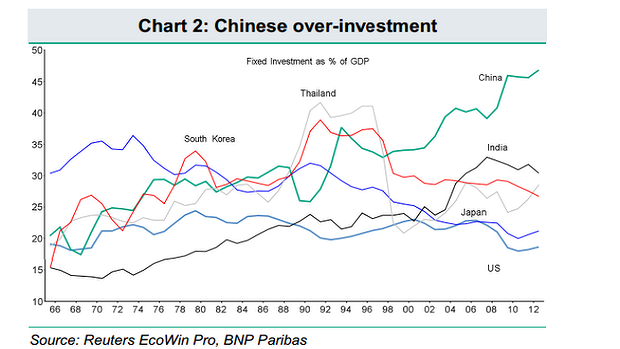
To rebalance China’s economy towards something near normal, growth in investment in physical capital will need to slow progressively to zero over the next decade and stay there, a tough ask when it has expanded at double-digit rates almost every year since the mid-1990s.
The country’s investment-to-GDP ratio is “the stand-out imbalance” in the economy; at 50 per cent the ratio is “beyond anything any other country has managed to achieve, let alone sustain,” write BNP Paribas economists in a new note to clients.
“Investment is the part of [Chinese] GDP set to suffer the most wrenching adjustment. For the economy to grow at the circa 8 per cent annualised pace that will be required over the remainder of the year to hit the 2014 growth target, credit growth will have to be pushed back up towards at least 20 per cent.”
“This inevitably increases the downside risks to the economy in 2015 and beyond” – something authorities may not be prepared to do, which is why the BNP economists expect growth to slow below 7 per cent in 2015. And if authorities do push ahead with rapid financial reforms, then Chinese economic growth could slow to 5 to 6 per cent by the end of the decade.
They don’t say it, of course, but such an outcome will trigger a very swift Australian adjustment of historic proportions, considerably more difficult than that facing China.
Hard to believe the elite of Australia took the punt and structurally adjusted the economy towards endless Chinese building, no?
David Llewellyn-Smith is Chief Strategist at the MB Fund and MB Super. David is the founding publisher and editor of MacroBusiness and was the founding publisher and global economy editor of The Diplomat, the Asia Pacific's leading geo-politics and economics portal.
He is also a former gold trader and economic commentator at The Sydney Morning Herald, The Age, the ABC and Business Spectator. He is the co-author of The Great Crash of 2008 with Ross Garnaut and was the editor of the second Garnaut Climate Change Review.