Via FTAlphaville comes this from Credit Suisse helping explain why China’s troubled trust sector has so far managed through:
A combination of bank rollovers, local government bailouts and asset management companies acquisitions has made the distress of trust funds easier to handle in the near term. There are nine cases of reported trust fund defaults in the first five months of this year, matching the number of defaults for the entire year last year. We estimate at least a dozen near defaults took place in May but were bailed out in various ways and have been managed without being exposed to the press. The frequency of trust fund defaults is clearly rising, but not nearly as quickly and contingently as the bear camp had imagined. Certainly, the news flow has not poisoned market sentiment in material ways.
Because of the rollover and local government short-term financing, our research suggests that the peak of trust fund repayments has been pushed back from mid- 2014 to early 2015:
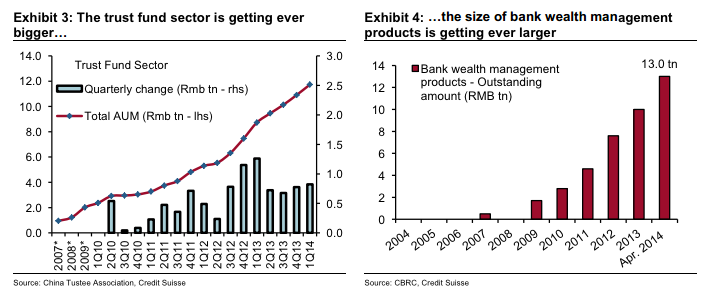
Does this mean the trust fund default risks, or shadow banking risks, have reduced? Yes, but only at the margin, the risks seem slightly lower now than six months ago and the government has a little more time to sort it out. Trust funds’ ability to find a way to rollover and to stay away from negative press exposure seems impressive, for now. But the default risk remains untackled, in fact, trust funds and shadow banking in general are growing even bigger.
First, local governments and their investment vehicles have limited fiscal strength. The central government is visibly missing from rescue actions. In fact, we do not rule out the possibility of Beijing “teaching a lesson” to the local governments in 2H14, to eliminate the moral hazard. Without Beijing’s help, we do not see how the local governments can handle the overwhelming size of debt payments.
Second, while default news is rare at this moment, many trust funds have stopped making interest payments. That should make it really hard when they seek to rollover when existing funds are unwinding. Meanwhile, banks are nowadays more cautious and selective about selling high yield WMPs to their customers. That reduces money flows to infrastructure projects, setting a process in motion for future defaults.
Third, the property market has experienced shrinking transaction volumes. A big wave of property-related trust funds will face the pressure of repayment in 1H15. If property market transaction volumes do not see a major and sustained rally, we suspect defaults will appear in large scale. Unlike the local government investment vehicles, developers usually do not have the backing of a local government.
Fourth, many commodity-focused trust funds are in deep distress, as their asset values nosedived when commodity prices turning south. The anti-corruption campaign also undermines the prospects of these funds.
Fifth, the government has started to focus on lowering the funding costs of shadow banking, as the double-digit interest rates are deemed to be hurting the real economy.
These kinds of corrections always take longer than one expects, especially in China.
David Llewellyn-Smith is Chief Strategist at the MB Fund and MB Super. David is the founding publisher and editor of MacroBusiness and was the founding publisher and global economy editor of The Diplomat, the Asia Pacific's leading geo-politics and economics portal.
He is also a former gold trader and economic commentator at The Sydney Morning Herald, The Age, the ABC and Business Spectator. He is the co-author of The Great Crash of 2008 with Ross Garnaut and was the editor of the second Garnaut Climate Change Review.