On May 12, People’s Bank of China (PBoC) summoned the heads of the 15 largest commercial banks and asked them to prioritize the granting of first home mortgages.
While this may give the market some short term sentiment support, it will not change the medium term downward trend in the market in our view for a few reasons: 1) we doubt that banks will rush out with mortgages; 2) even a meaningful increase in mortgage supply shouldn’t fundamentally change the worsening property market conditions; 3) even a strong rebound in housing demand does little to address the core-issue facing the economy and the market, i.e. overcapacity and over-leverage in the corporate sector. We recommend investors to sell into any market rebound on the back of this news.
Barring a hard mortgage quota imposed on banks by PBoC, we doubt that there will be any big acceleration of mortgage granting by commercial banks despite the May 12 meeting. Nowadays, banks’ number 1 goal is profit – mortgage is simply no longer as attractive given the rising risks in the property market, the banks’ high funding costs and relatively low mortgage rates. The difficulty with controlling banks’ off-balance sheet activities has amply demonstrated that administrative orders are no longer effective. PBoC’s comments at the meeting, including asking banks to control credit risk when granting mortgages, give banks enough leeway not to rush out with mortgages by our assessment.
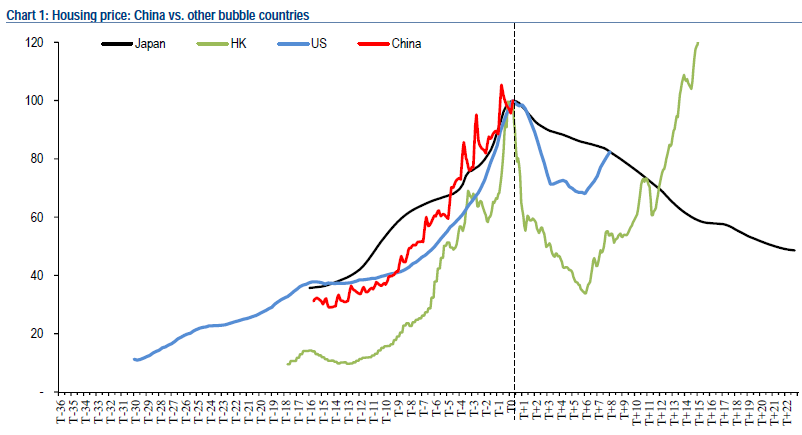
In our view, the big picture in the property market is 1) housing price has risen by rough 1.6x over the past ten years and affordability for genuine-demand home buyers is low; 2) real interest rate is firmly in positive territory so investors no longer consider buying properties a must; 3) under balance sheet pressure, developers are forced to cut prices which probably will reduce demand (potential buyers will likely wait and see); and 4) China has most likely significantly overbuilt with per capita living space already among the highest in the world. The new leaders’ heart is in reforms and to rein in debt growth, rather than protecting short term GDP growth. So we doubt they will rush out with significant propertyboosting measures anytime soon (like what the government did in late 2008).
Citi sees greater stimulus but the same outcome:
We have been highlighting that the physical market has reached a critical point, with the sector under greater pressure even than in the FY08/11 downcycle given current drags like a weaker economy, RMB depreciation, the anti-corruption drive, and outflows of purchasing power to overseas. To avert a potentially serious correction, more powerful measures will need to be adopted in a timely fashion, in our view, including 1) HPR relaxation – we expect more key cities (except Tier 1) will relax the HPR from now till Jun/July; 2) Credit easing – more favorable terms for mortgage costs/ downpayments: and 3) Resetting of buyers’ ASP expectations with less negative media reporting. If such measures are not implemented by June/July, the risk is of a significant and imminent correction.
Near-term moderate share-price rebound hinges on strong loosening and pick-up in sales: After the prosperity of the past 15 years, a correction in China’s property market would not be hugely surprising, and would be aligned to overall economic growth in China. Strong loosening measures would help stabilize this downtrend but not reverse it. Meanwhile, heavy recent short-selling of China property stocks could set up a moderate rebound for sector share prices, in our view, if we see both i) strong policy loosening on HPR and credit easing; and ii) a moderate pick-up in May/June sales of key developers after more launches/competitive pricing. Our top picks in positioning for this potential rebound remain quality names such as COLI, Vanke, Shimao and Sunac.
David Llewellyn-Smith is Chief Strategist at the MB Fund and MB Super. David is the founding publisher and editor of MacroBusiness and was the founding publisher and global economy editor of The Diplomat, the Asia Pacific's leading geo-politics and economics portal.
He is also a former gold trader and economic commentator at The Sydney Morning Herald, The Age, the ABC and Business Spectator. He is the co-author of The Great Crash of 2008 with Ross Garnaut and was the editor of the second Garnaut Climate Change Review.