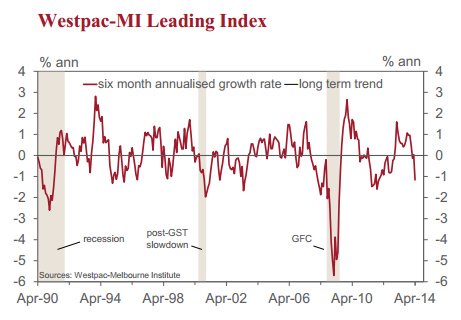
I have well documented issues with this index but there’s no doubt what it is signalling ahead today:
• The six month annualised deviation from trend growth rate of the Westpac Melbourne Institute Leading Index which indicates the likely pace of economic growth three to nine months into the future fell to –1.16% in April from +0.03% in March.
This is a sharply weaker reading that points to a significant loss of momentum. The May Leading Index reading is the weakest since late 2011, when the RBA embarked on its latest interest rate easing cycle. At that time, Europe’s sovereign debt crisis was in full swing and consumer sentiment had slumped heavily”.
The latest Leading Index reading is not quite as weak as the lows in 2011 but there are some similarities with that episode. The latest decline has also been associated with a sharp fall in consumer sentiment and deteriorating external conditions (declining commodity prices and slowing growth in US industrial production).
However, some factors contributing to the current slowdown may prove to be temporary. The sharp decline in consumer sentiment was largely a negative reaction to the May Budget that may reverse or dissipate over time. Other Index components may also have been affected by the timing of public holidays in April and adverse weather conditions in the US.
While it is milder than 2011, and may be being exaggerated a little by transitory factors, the most disconcerting feature of the current slowdown in the Leading Index is its broad base. All components have contributed to the swing from above to below trend growth. The Index deliberately draws on a wide range of information sources covering different areas of the economy in part to avoid ‘quirks’ in any one data source driving the headline result. While there may be some quirks in the latest readings, the fact that the slowdown is corroborated across all components is a strong indication that a genuine slowdown is underway.
The Index’s six month annualised growth rate has turned abruptly since November, swinging from 0.97% above trend to 1.16% below trend in April. The biggest drivers of the 2.13ppt turnaround have been: a narrowing in interest rate spreads (–0.52ppts); declining aggregate monthly hours worked (–0.41ppts); a sharp fall in the Westpac-MI Consumer Sentiment Expectations Index (–0.35ppts); and declining dwelling approvals after a strong surge in 2013 (–0.32ppts). The remaining components contributed a further –0.52ppts to the slowdown with all components contributing to the slowdown in the six month growth rate.
For the April month, the overall level of the Index fell from 98.50 in March to 98.00. Two components posted monthly improvements: the S&P/ASX 200 (up 1.3%) and the Westpac- Melbourne Institute Unemployment Expectations index (down 0.5% representing a lower, i.e. improved, outlook for unemployment). All other components deteriorated in the month with the Westpac-Melbourne Institute Expectations Index down sharply (–9.8%), a 4.3% drop in dwelling approvals, a 3.9% fall in commodity prices, a 2.5% fall in aggregate monthly hours worked, a small 0.6% decline in US industrial production and a 10bps narrowing in the yield spread.
The Reserve Bank Board next meets on June 3. As indicated in the minutes of the May Board meeting, the RBA expects to keep rates on hold ‘for some time yet’. The sharp loss of momentum apparent in the Leading Index will clearly encourage the Bank to maintain this stance.
David Llewellyn-Smith is Chief Strategist at the MB Fund and MB Super. David is the founding publisher and editor of MacroBusiness and was the founding publisher and global economy editor of The Diplomat, the Asia Pacific's leading geo-politics and economics portal.
He is also a former gold trader and economic commentator at The Sydney Morning Herald, The Age, the ABC and Business Spectator. He is the co-author of The Great Crash of 2008 with Ross Garnaut and was the editor of the second Garnaut Climate Change Review.