Remember that fantastic Pascometer moment that marked the very top of the commodity super cycle:
Even if you think you know the “Chindia” story, odds are you don’t really know the Chindia story. And if you’re still caught up in China “housing bubble” and US-consumer-dependency yarns, you’re blinded by Western conceit and actually don’t have a clue.
Well, it’s back today, this time from Paul Bloxham at HSBC:
‘Com-Modi-ty’ demand may be set to rise
The recent election of Narendra Modi and the Bharatiya Janata Party (BJP) in a decisive victory has given his government a strong mandate for reform. While our team are of the view that change will take time and the economic recovery is likely to be protracted (see Neumann, F. 2014), they also note that the new government is likely to prioritise infrastructure development. This is typically a key source of demand for hard commodities.
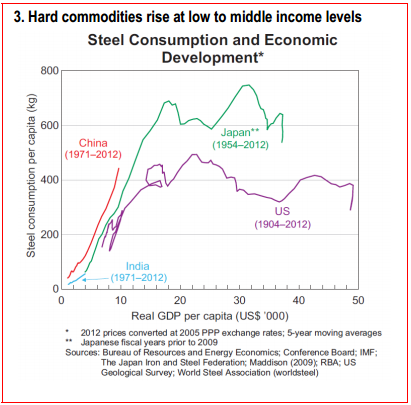
At this stage, India’s demand for most types of commodities is very low, largely reflecting its low level of per capita GDP. However, historical patterns from other countries suggest that it is at around India’s current level of development (per capita GDP of around USD 4000 in PPP terms) that commodity demand, particularly for hard commodities, tends to take off. This typically reflects that at this level of development, a country’s industrialisation and urbanisation usually requires significant amounts of energy and metals.
In this regard, it is worth remembering how quickly commodity demand from China ramped up a decade ago and then began to outpace domestic supply. This drove a sharp rise in a range of commodity prices: what many analysts have called a ‘Super Cycle’.
Given India’s large population, we believe it is fair to argue that a rapid pick-up in per capita commodity consumption could have a significant impact on global demand.
India’s commodity demand has so far been stymied by a lack infrastructure development, a poorer quality housing stock than other countries (particularly when compared to China), and a development path that has been led by the services sector rather than manufacturing. The recent change of government could be a trigger for a shift in direction for India’s commodity demand. While picking the timing is difficult, the commodities story may be more supported by India in coming years than has been the case so far.
Advertisement
While the power of positive thinking can be useful in investment, India is held back by deeply entrenched inequality, extraordinary bureaucratic and political complexity, and a culture that is far less enamoured of development in general than is China. There is also no reason to think that India is likely to push into more infrastructure-dependent manufacturing development. If it had an edge on that front it would already be apparent. I reckon a continuation of the previous trend of good but not stellar growth based around services is a more than a fair bet.
David Llewellyn-Smith is Chief Strategist at the MB Fund and MB Super. David is the founding publisher and editor of MacroBusiness and was the founding publisher and global economy editor of The Diplomat, the Asia Pacific's leading geo-politics and economics portal.
He is also a former gold trader and economic commentator at The Sydney Morning Herald, The Age, the ABC and Business Spectator. He is the co-author of The Great Crash of 2008 with Ross Garnaut and was the editor of the second Garnaut Climate Change Review.