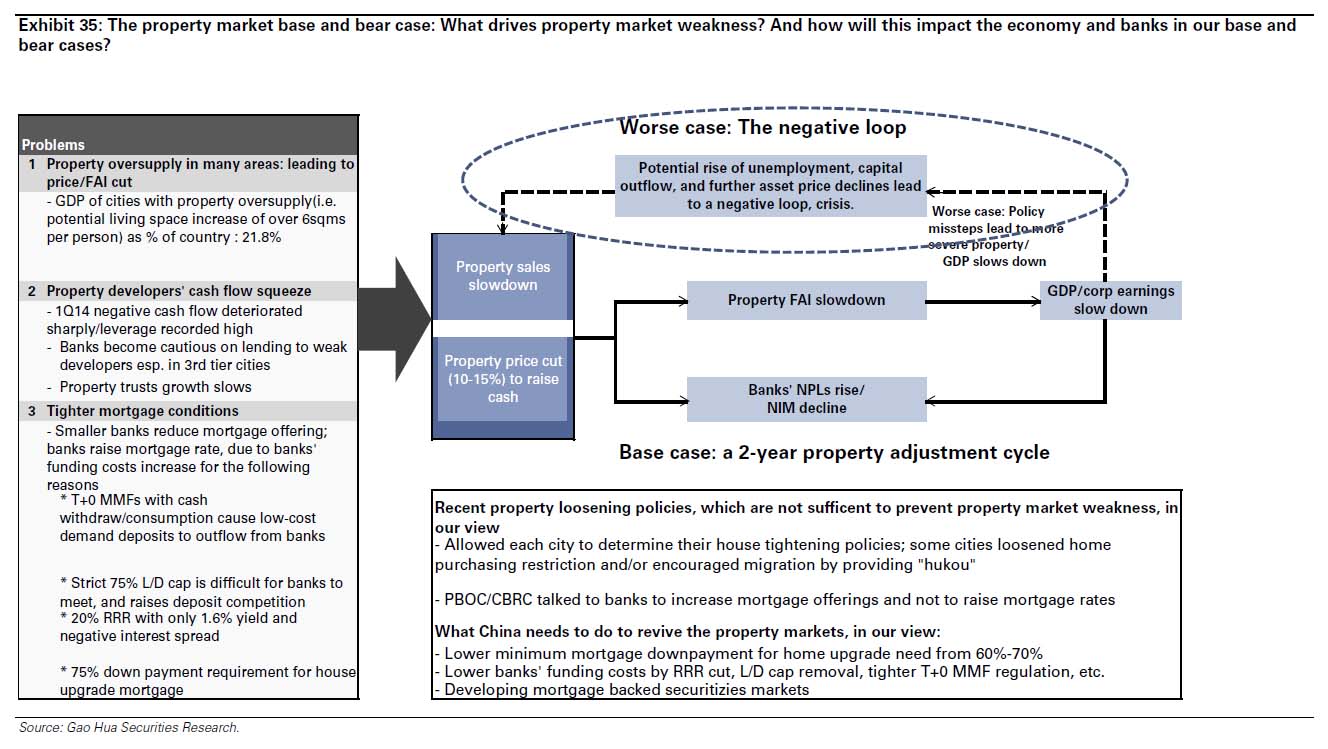
Some more scenario analysis today from Goldman on what could go wrong in China’s property shakeout:
We are concerned about policy uncertainties, and the possibility that potential policy changes could be too little or too late. In particular, we believe potential policy missteps could lead to a self-fulfilling bear-case scenario, i.e. further property market weakness, which could in turn lead to weak corporate earnings, rising unemployment, forex outflow, lower GDP and bank asset quality risks.
We believe the two policies discussed below are critical in preventing a prolonged property market slowdown while not increasing the property over-investment risks:
Lower the minimum down-payment ratio for property upgrades, e.g. to 50% from the current 60% (nationwide) and 70% (in some big cities).
We note that during the housing reform in 2001 when many government and SOE employees obtained subsidized houses from the government at much reduced prices, China house-ownership within urban areas already reached c. 80%, according to the Ministry of Housing.
As such, property demand has been mainly driven by households improving their living standard, or upgrading need. In 2011, to control housing prices, China adopted a mortgage policy that imposed minimum 60% downpayment ratios for second home purchases. Second home purchase is defined as: 1) a family that already has a flat; or 2) a family that historically already borrowed a mortgage (even though the family already paid off the mortgage and no longer owns the flat).
We believe such a high down payment for second homes effectively significantly hurt property upgrade needs, which is the main demand for property markets, rather than the first home purchase.
As such, we believe lower downpayment ratios for second home purchases will be fundamentally positive for increased property demand, while not increasing property bubble risks as China still prohibits the purchase of third homes.
Lower the funding costs for mortgage and corporate sectors, by RRR cut, removal of loan/deposit ratios, etc., per our earlier discussion.
That said, we are not sure whether these policies will be changed, and when.
In the bear case, if China fails to address the above-mentioned policy mix, we believe worse-than-expected mortgage rate rise could lead to a more severe property downturn, a FAI/GDP slowdown, and corporate earnings weakness, and in turn, could lead to higher unemployment, forex outflow, and more GDP/property/banks’ asset quality downside risks.
We define our base case assumptions for bank earnings estimates below:
China selectively eases mortgage policies for property upgrade needs in certain areas in 4Q14 (on May 12, 2014, PBOC held a meeting with banks to encourage mortgage offering);
No RRR cut. China banks’ funding costs continue to rise, which retain relatively high corporate/mortgage funding costs.
David Llewellyn-Smith is Chief Strategist at the MB Fund and MB Super. David is the founding publisher and editor of MacroBusiness and was the founding publisher and global economy editor of The Diplomat, the Asia Pacific's leading geo-politics and economics portal.
He is also a former gold trader and economic commentator at The Sydney Morning Herald, The Age, the ABC and Business Spectator. He is the co-author of The Great Crash of 2008 with Ross Garnaut and was the editor of the second Garnaut Climate Change Review.