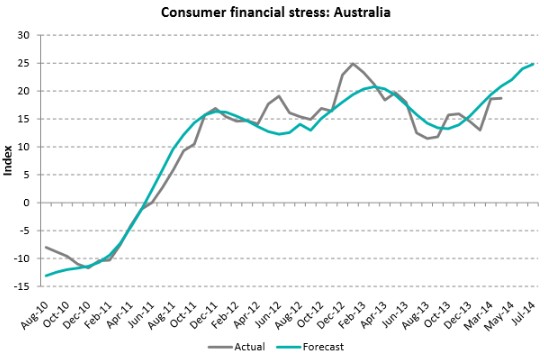
Dunn & Bradstreet has released a new report which forecasts an increase in consumer stress on account of low wages growth, high household debt, and the Budget:
Financial stress was heightened during April and is set to worsen in the next three months as slow wages growth, high household debt and costs of living impact consumers’ capacity to manage their finances.
After improving through the second half of 2013 as record-low interest rates and a focus on savings improved the financial position of Australians, Dun & Bradstreet’s Consumer Financial Stress Index has risen from 13 points in January to 18.7 points in April.
By July the index is forecast to hit 24.8 points, the second highest level in its four-year history, as consumers find it more difficult to make their finance repayments and the quality of credit applications deteriorates.
With household income and sentiment expected to be impacted by the Federal Budget, and first quarter figures from the ABS showing that wages grew at a moderate 0.7 per cent, the credit bureau anticipates its stress forecast will trend in a higher range as the year progresses.
Advertisement
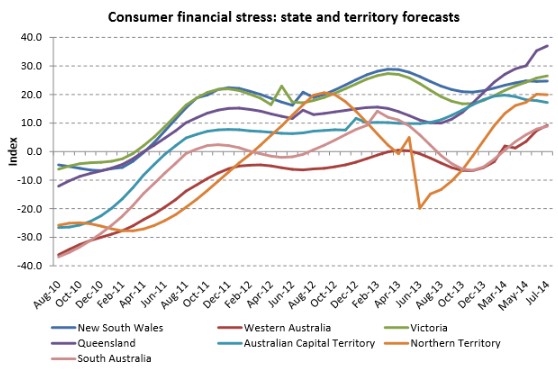
Consumer stress levels have been rising pretty much everywhere, except New South Wales:
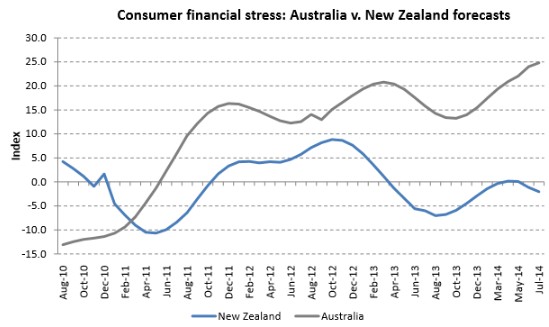
And an interesting dichotomy has formed between Australian and New Zealand households, with our cousins across the pond far more upbeat:
Advertisement
Finally, the Kouk continues his transformation from bull to bear:
“It is looming as a genuine threat to the recent strength in spending, if consumers respond to financial difficulty by paring back expenditure.”
“Causes of the rise in consumer financial stress are hard to pinpoint, but appear linked to the still weak growth in household incomes, accelerating credit growth and a still fragile jobs market. While the current low level of interest rates is helping to alleviate consumer financial stress, this is clearly being overwhelmed by other negative factors.”
“The Reserve Bank is unlikely to increase interest rates with consumers on the cusp of scaling back their spending,” Mr Koukoulas noted.
Leith van Onselen is Chief Economist at the MB Fund and MB Super. He is also a co-founder of MacroBusiness.
Leith has previously worked at the Australian Treasury, Victorian Treasury and Goldman Sachs.