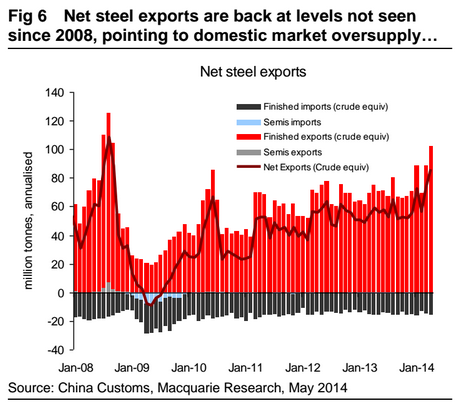
Since China’s slowing domestic demand for steel began this year and prices have plumbed new lows, cheap exports have begun flooding into broader markets and a backlash is brewing. From the WSJ:
…The U.S. Commerce Department recently made a preliminary determination that grain-oriented electrical steel from China is being dumped in the U.S. In March, U.S. trade officials said such Chinese steel benefited from unfair government subsidies. Analysts say U.S. steel companies are ramping up efforts to get Washington to increase tariffs on Chinese steel imports.
In February, European steel lobby Eurofer said it planned to file antidumping complaints this year with the European Commission against Chinese exports of cold-rolled stainless steel. The agency couldn’t immediately be reached for comment on Tuesday.
Canada, Australia and Southeast Asian countries also have begun antidumping investigations into Chinese steel products in recent years.
Exports of low-cost construction steel still dominate China’s trade with emerging regions such as Southeast Asia, said Suaik Lim, a director at Fitch Ratings. “It may not lead as much to political friction, but it will lead to trade protection repercussions,” Mr. Lim said.
While Southeast Asian nations haven’t engaged in a full-fledged trade war with China, they often join with the U.S. or other large jurisdictions as third parties in disputes taken to the World Trade Organization.
Steel is a strategic commodity that most nations tend to protect. Tensions won’t be helped either by the PBOC move to weaken the yuan.
If the Chinese over-production continues and it keeps getting dumped offshore then these tariff barriers are going to rise. That, in turn, will exacerbate the plight of unprofitable Chinese steel makers.
David Llewellyn-Smith is Chief Strategist at the MB Fund and MB Super. David is the founding publisher and editor of MacroBusiness and was the founding publisher and global economy editor of The Diplomat, the Asia Pacific's leading geo-politics and economics portal.
He is also a former gold trader and economic commentator at The Sydney Morning Herald, The Age, the ABC and Business Spectator. He is the co-author of The Great Crash of 2008 with Ross Garnaut and was the editor of the second Garnaut Climate Change Review.