

Analysis today from ANZ about China’s inflation rate has me a little bemused. From the SMH blog:
- As the inflation pressures remain mild, the PBoC is likely to maintain the current accommodative monetary policy stance, and the market liquidity conditions will remain relaxed in general.
- However, the commercial banks were still quite cautious about the liquidity outlook, and the lending rates to the corporates remained elevated in Q1 2014.
- From this perspective, the PBoC needs to send out a clearer policy easing signal, such as cutting the reserve requirement ratio (RRR), to help alleviate the funding costs for the real economy.
Similar came from HSBC:
March headline CPI rebounded to 2.4%y-o-y although this was mainly due to base effects. However, the contraction in PPI deepened to -2.3 %y-o-y, an eight-month low, partly attributable to the falling international commodities prices. With demand condition sluggish and inflation not a threat for the foreseeable future, the central bank is likely to maintain a relatively accommodative monetary policy stance to support growth.
These two banks are the most China bullish that I follow and both have been expecting Chinese easing for many months without luck. Now it appears they have delivered that easing themselves.
It’s worth noting that yesterday in its regular open market operations, the People’s Bank of China did inject liquidity into interbank markets for the first time in several months. From Xinhua:
The People’s Bank of China (PBOC) said in a statement that it conducted a 14-day repo of 70 billion yuan at a bid rate of 3.8 percent and a 28-day repo of 44 billion yuan at 4 percent.
Together with the repos of 63 billion yuan on Tuesday, the liquidity injected by the central bank will stand at 55 billion yuan, deducting 232 billion yuan worth of repos due this week.
The PBoC has drained liquidity through open market operations in the past eight weeks, which withdrew capital of 62 billion yuan and 98 billion yuan respectively in the past two weeks.
China’s liquidity is affected by funds outstanding for foreign exchange, which saw a slower rise of 120 billion yuan in February from the 430-billion yuan increase in January, according to the central bank.
Zhong Zhengsheng, chief macroeconomic researcher with Guosen Securities, said that the moderate interest rate in the monetary market will lead to steady growth in funds outstanding for foreign exchange.
Analyst Yang Weijiao said that the liquidity injection this week came from capital that was due, which meant no need for any changes in central monetary policies.
But it’s too early to call that “accomodative” given that it is offsetting the collapse in hot money inflows that liquify the shadow bank sector. Short dated SHIBOR rates have been volatile but there’s no obvious easing:
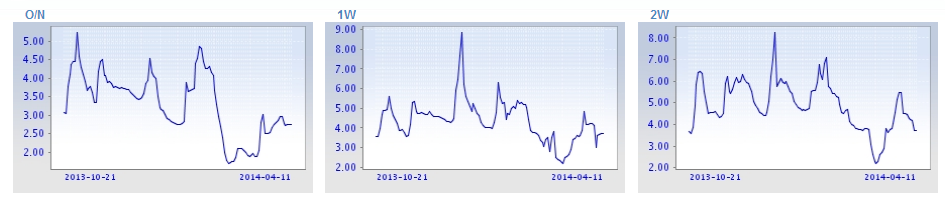
It’s always difficult to judge the credit outcome from these rates over the short run. Sometimes rates are tight/loose owing to lending conditions not PBOC activity. Post CNY rates have been lower than last year but so has lending demand as property and other sectors slow.
The trend of mild tightness appears intact but the proof of the pudding will be March credit data which is due out any minute. If it can match or better last year’s March spike, I’ll take the loosening argument more seriously.
