From Capital Economics comes a sensible commentary on China’s new “stimulus”:
…the State Council included commitments for spending on railways, increasing financing for affordable homes, and the extension of a preferential tax policy for small businesses. The goal, the statement said, was to “stabilise growth”.
This is being heralded as stimulus by some, but it falls a long way short. Many – perhaps all – of these steps were already in the pipeline. For example, the State Council pledged that 6,600km of new railway lines would be built this year. The head of the state-owned China Railway Corporation announced the same back in January. The growth rate is little changed from recent years. (See Chart 1.)
Similarly, this year’s budget report, delivered at the National People’s Congress (NPC) a month ago, already included an almost-identical promise to expand preferential tax policies for small firms (“we will further expand the preferential tax policies for small enterprises”).
The commitment to affordable housing is also repeated from the premier’s report to the NPC, with some extra details on how the spending will be financed.
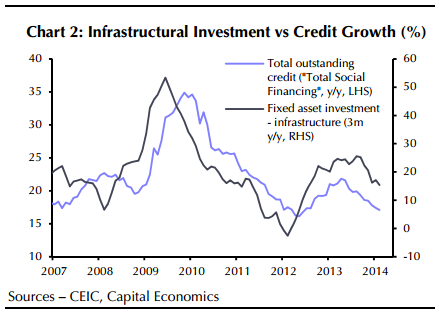
In other words, no-one should go changing their annual GDP forecasts as a result of this statement. At most, some spending that may otherwise have happened later in the year may be brought forward. The trajectory is more likely to resemble mid-2013, when infrastructure investment growth held up while credit slowed, rather than 2012, when both investment and credit rebounded. (See Chart 2.)
This relative sanguine view of the outlook also seems to be held by the People’s Bank. A report on the PBOC’s Q1 meeting of its Monetary Policy Committee, just published on its website, leads with the statement that the economy is “still in a reasonable range”. Meanwhile, the PBOC this week has continued to drain liquidity from the interbank market over the past couple of weeks, pushing market interest rates higher. These are not the actions of policymakers prioritising growth over all else.
Nope, they are not. China is going to keep slowing steadily and squeeze out its ponzi borrowers. Credit Suisse agrees:
● Three measures were launched: (1) lowering the entry point for corporate tax for small enterprises from Rmb120,000 to Rmb60,000 per year; (2) speeding up reconstruction of slums as part of the urbanisation plan; and (3) pushing forward the railway construction projects with state funding and bond issuance mechanism.
● The overall size of these projects is estimated around Rmb500 bn. This should become an additional stabilisation force for 2Q growth. We will not change our growth forecast, currently at 7% QoQ annualised for 2Q14, based on this news.
David Llewellyn-Smith is Chief Strategist at the MB Fund and MB Super. David is the founding publisher and editor of MacroBusiness and was the founding publisher and global economy editor of The Diplomat, the Asia Pacific's leading geo-politics and economics portal.
He is also a former gold trader and economic commentator at The Sydney Morning Herald, The Age, the ABC and Business Spectator. He is the co-author of The Great Crash of 2008 with Ross Garnaut and was the editor of the second Garnaut Climate Change Review.