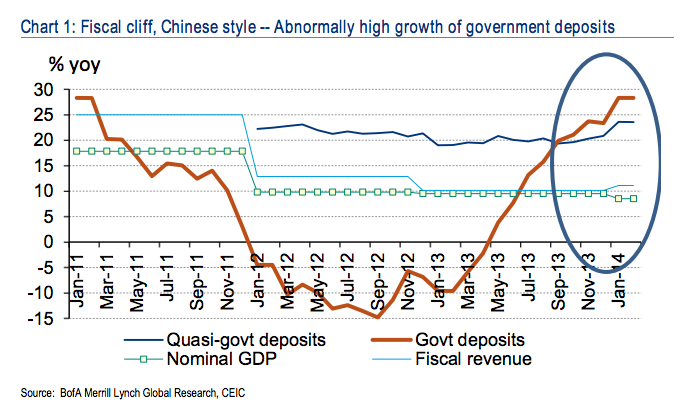
There could be some elements of truth in the views above, but we believe the major drag is the contractionary fiscal policy as a consequence of Beijing’s anti- corruption and anti-vice campaign which was started at the beginning of last year and was significantly escalated this year. The strong evidence was the abnormally high growth of bank deposits of governments and quasi-government agencies (up 28.3% and 23.6% yoy in February 2014 respectively), a significant slowdown in retail sales growth, and some deceleration in FAI growth…
The impact of anti-corruption and anti-vice campaigns on consumption is straightforward, but why could FAI be affected?
First, the room for potential corruption might be greatly squeezed as a result of the anti-corruption campaign, so some officials are disincentivized from starting new projects. Second, even honest officials with clean hands might be discouraged from initiating new projects as they may be afraid of being perceived or even charged as being corrupt during the campaign. Inaction might be viewed as the safest way for self- protection amid a political movement….
We here provide a back-of-the-envelope estimate. For the government, we just assume that there is no need to increase deposits faster than economic growth, so the benchmark is just the 10% or so nominal GDP growth in 2013. Based on this method, we estimate fiscal contraction as a result of rising government savings in 2013 was around RMB326bn (or about 63bp of GDP in 2012). With adjustment on inflation, impact of the government’s fiscal contraction could be around 60bp on annual real GDP growth.
For quasi-government agencies such as schools and government research institutions, all public media including TV stations and newspapers, the appropriate benchmark might be growth of overall deposits at 13.8% in 2013. Using this method, the fiscal contraction of weak quasi-government consumption was at RMB937bn in 2013 (or 180bp of GDP in 2012). This is a big number and we don’t want to make too big calls as some of the quasi-government agencies might be fully out of the control of the government. In this regard, we can perhaps assume the actual fiscal contraction impact of those quasi-government agencies is around 90bp on real annual GDP growth (assuming close to half of those quasi-government agencies are out of government control and factoring in some CPI inflation).
If you’re wondering how clamping down on a bit of graft could have such a macroeconomic impact then consider that the current target of the anti-corruption drive, ex-security chief Zhou Yongkang, has had Rmb100bn ($16bn) worth of assets seized from his family and associates. As Alphaville notes, the FT goes on to describe an epic system of patronage under threat:
If Mr Zhou, 71, goes on trial and is convicted, he will be the most senior official to be found guilty of corruption since the founding of the People’s Republic in 1949.
Mr Zhou’s corruption case has sent shockwaves throughout business and government bureaucracies. Since he formally stepped down a year ago, hundreds of officials and businessmen who owed their glittering careers to his ascent – including minister-level bureaucrats from the security services, state oil companies and the state asset administrator – have been detained on corruption charges.
The decision to purge him publicly will probably provide the climax for an anti-corruption campaign that has been the signature policy of Xi Jinping, the Chinese president, since he came to power more than a year ago…
…the purge of Mr Zhou also exposes the biggest obstacle the authoritarian system faces as it seeks to cleanse itself of graft: the sheer size of informal power structures such as his.
Even if Mr Xi is intent on removing the rot at the top of the system, he cannot attack other senior leaders and their patronage networks because doing so would destabilise the entire Chinese power structure.
David Llewellyn-Smith is Chief Strategist at the MB Fund and MB Super. David is the founding publisher and editor of MacroBusiness and was the founding publisher and global economy editor of The Diplomat, the Asia Pacific's leading geo-politics and economics portal.
He is also a former gold trader and economic commentator at The Sydney Morning Herald, The Age, the ABC and Business Spectator. He is the co-author of The Great Crash of 2008 with Ross Garnaut and was the editor of the second Garnaut Climate Change Review.