

Roy Morgan Research (RMR) last night released its unemployment estimate for the month of February, which registered a large jump in the unemployment rate to 12.3% from 11.3% in January (see next chart).
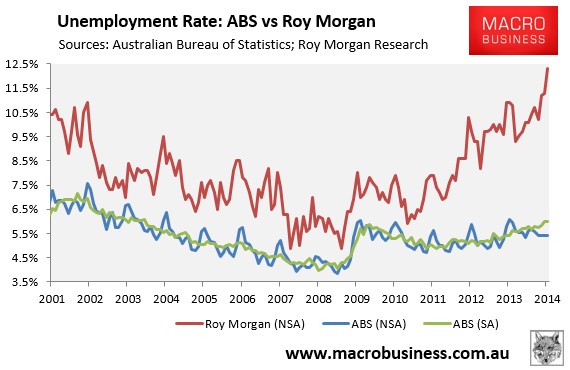
It was the highest unemployment rate recorded by RMR since February 1994.
According to Gary Morgan:
“Australian unemployment has increased to a record high 1.561 million Australians (12.3%, up 1.0%) in February. This is the highest rate of unemployment in 20 years – since February 1994 (12.3%, 1,075,000). An additional 1.080 million Australians (8.5%, down 0.2%) are under-employed – a total of 2.641 million (20.8%) Australians unemployed or under-employed – a new record high…
Analysing the results by age group also reveals unemployment to be heavily concentrated amongst the young: 18-24yr olds (28.0%, up 6.8% in February), have far higher unemployment than any other age group; ahead of 25-34yr olds (12.4%, up 1.3%), 50-64yr olds (9.3%, up 0.1%), 35-49yr olds (8.9%, down 0.5%) and those aged 65+ yrs old (5.2%, up 2.7%). An additional 16.1% (up 1.4%) of 18-24 yr olds are under-employed – which is also far higher than any other age group – a total of 44.1% of 18-24yr olds unemployed or under-employed.
“The figures highlight a reality seen repeatedly during economic downturns – younger people are the first to lose their employment or have their hours reduced. The spike in youth unemployment is therefore often a leading indicator of higher unemployment for older age groups. However, it is also worth remembering that many younger people who have been searching for work over the Summer months will return to their studies in March as University recommences. This is an annual trend which decreases youth unemployment each year which we would expect to see next month.
“The continuing rise in unemployment – which has now increased in eight out of the last ten months since hitting a low of 9.3% in April 2013 – is a huge concern for the Abbott Government as it gets set to deliver its first Federal Budget in two months’ time. In February alone Qantas announced plans to heavily slash costs (An expected 5,000 jobs lost), Toyota announced it was ceasing car manufacturing in Australia (A minimum of 2,500 jobs lost), Alcoa announced it was closing several smelters (1,000 jobs lost), Telstra announced plans to cut its directories division (800 jobs lost) and today IBM has announced it plans to cut a further 500 jobs.
“These job losses attract the headlines, but smaller businesses are also shedding jobs – and as the Roy Morgan figures show, younger Australians are finding it harder and harder to find employment.
As explained previously, RMR measures employment differently from the ABS:
According to the ABS definition, a person who has worked for one hour or more for payment or someone who has worked without pay in a family business, is considered employed regardless of whether they consider themselves employed or not.
The ABS definition also details that if a respondent is not actively looking for work (ie: applying for work, answering job advertisements, being registered with Centre-link or tendering for work), they are not considered to be unemployed.
The Roy Morgan survey, in contrast, defines any respondent who is not employed full or part-time and who is looking for paid employment as being unemployed…
Since Roy Morgan uses a broader definition of unemployment than the ABS, it necessarily reports a higher unemployment figure. In addition, Roy Morgan’s measure tends to be far more volatile, owing to the fact that it draws on a smaller sample than the ABS and is not seasonally adjusted.
Both the official ABS unemployment rate and the unofficial RMR measure tracked each other closely until mid-2010 before diverging sharply (see next chart).
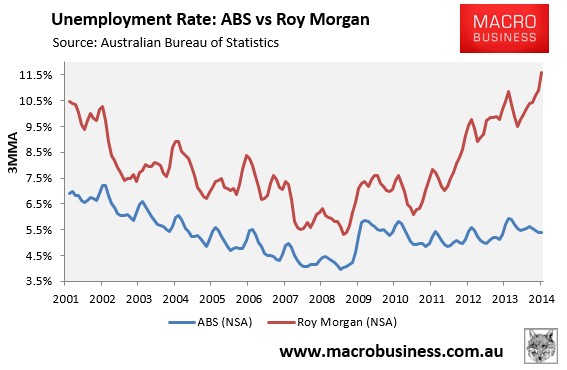
The reasons behind the big divergence between the RMR and ABS unemployment measures since mid-2010 remains a mystery, but probably has something to do with RMR’s picking-up discouraged workers. Because the measure is not seasonally adjusted it also jumps at the beginning of each year as school leavers hit the jobs market.
In any event, the trend in the RMR survey confirms that the Australian labour market remains weak, with jobs growth well below the level required to soak-up the growing population.
unconventionaleconomist@hotmail.com
