
Let me start by adding my two cents worth on China’s January lending data out last Friday. Here are the charts:
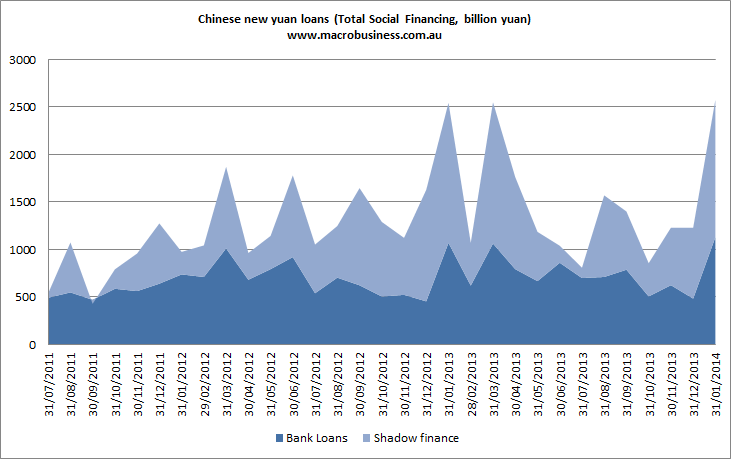
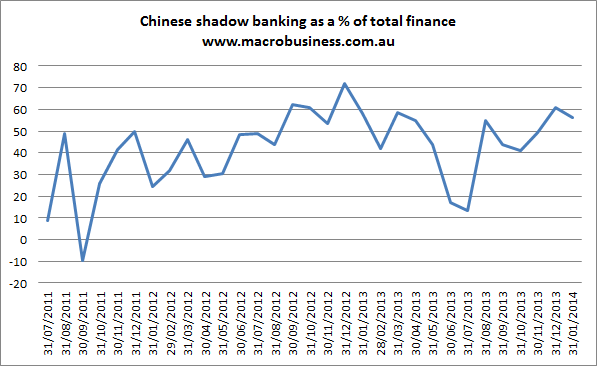
Note: these figures are higher than those we reported Friday, sorry!
A few points to note. The year on year growth figure for total credit is basically flat. It will take another few months to see how much of this is seasonally influenced but my guess is not much. Shadow banking remains significant.
You may recall that the huge jump last year led to much discussion that Chinese credit was passing through a crucial Minsky moment. The discussion was led by our old friend George Magnus then of UBS:
In the face of the sharp slowdown in growth in early 2012, the government decided to play safe, especially ahead of the leadership change in October, and allowed credit to reaccelerate. But if it hoped the investment side of the economy would spring to life, the outcome has been disappointing, at least so far. Instead – and it’s hard to be specific – credit expansion is taking on a more Minsky-ish character: refinancing of maturing bad debt, borrowing to service debt because of weak cash flows and negative commercial returns, and the financing of ‘investment’positions in real estate and commodities. It is estimated, for example, that banks rolled over some RMB 3 trillion, or three quarters, of loans to local governments that matured in 2012.1 And the IMF has noted that in the broadly defined corporate sector, company profits are failing to keep up with rising interest rate expense, obliging firms to seek recourse to borrowed funds.
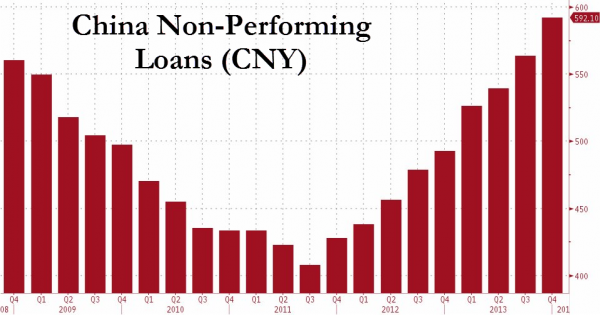
Later in the year growth did bounce back as fiscal spending was added to the mix but given the size of credit surge the bounce was muted (you may recall I expected growth to jump above 9% when I first saw it). It’s impossible to be decisive about this but there is enough evidence to conclude that the relationship between debt and growth is slipping in the Chinese economy. If so, as year on year credit peaks begin to show, you would expect the next domino to fall would be rising bad loans, and that’s where we are today. From Bloomie and ZH:
Chinese banks’ bad loans increased for the ninth straight quarter to the highest level since the 2008 financial crisis, highlighting pressures on asset quality and profit growth as the world’s second-largest economy slows.
Non-performing loans rose by 28.5 billion yuan ($4.7 billion) in the last quarter of 2013 to 592.1 billion yuan, the highest since September 2008, the China Banking Regulatory Commission said in a statement on its website yesterday.
…Chinese banks are struggling to keep soured loans in check and extend earnings growth as the slowing economy and government efforts to curb shadow financing make it harder for borrowers to repay debt.
“China’s economic growth turned downward with the new leadership switching policy focus to reform and risk management from emphasizing stable expansion,” said Wang Yichuan, a Wuhan-based analyst at Changjiang Securities Co. “Naturally the bad loans will increase along with the change. We expect the deterioration to continue for two more years.”
That’s optimistic if China is serious about rebalancing but let that slide. These rising bad loans are now causing some constipation in the shadow bank sector. From Nikkei (h/t ZH):
Concerns over potential defaults on high-yield financial products are making Chinese companies put some debt issues on hold due to wary investors, as well as posing a potential new risk to the global economy.
Since January, nine companies have postponed or canceled issuance plans for a total of 5.75 billion yuan ($948.24 million) in bonds and commercial paper, equivalent to about 2% of the debt issued over the period.
This is most pronounced among privately operated companies, whose lack of government backing has meant less interest from potential investors than hoped.
Demand has been dulled by worries over defaults on so-called wealth management products, a feature of China’s shadow banking system.
Broader credit risks have driven interest rates up, and the gap between corporate debt and more-creditworthy government bonds is widening. Average yields on AA-rated seven-year corporate bonds reached 8.44% in mid-January.
So even if companies offer bonds, they will be unable to raise money if they cannot pay these higher rates.
These numbers are small and Chinese interbank markets are currently easing not tightening as we come off the Lunar Holiday cash drain season. But the issue is the same here as it always is in shadow banking where quaint stuff like capital reserves and lenders of last resort have been replaced by the magic wand of financial engineering. Any default loosens the key stone in the edifice, investor confidence:
…”A default may occur in the first half of this year,” says Chen Li, a strategist at UBS Securities — and a growing portion of the market agrees.
While the government may intervene to keep principal safe, financial instability in China, the biggest export destination for Asia’s emerging markets, could pose a risk to the global economy.
“There’s a possibility that the Chinese government will step in to keep the negative impact from spreading,” says Hiromichi Tamura, chief strategist at Nomura Securities, “but if these types of repayment delays continue, they could trigger a global stock market downturn.”
That’s right, I think. Any clogging of Chinese shadow banking would not directly cause a global banking freeze. It is largely locally contained, is less complex than the cross-border monster that caused the GFC (though no less opaque), and the Chinese have various mechanisms to manage default that Western systems do not – bad banks, rubbery contracts, government suasion in lending standards etc. The source of contagion will be growth, falling growth that is, and the blow that that deals to emerging markets and the commodity complex.
So what does the January lending data tell us? It is plenty large enough to suggest that China’s credit channels remain wide open. Equally, fiscal and PBOC tightening will continue and bad debts keep rising. Growth should continue to grind lower over the medium term.
