

There’s more analysis today of the employment crunch coming to Victoria following the announced closure of Australia’s automotive assembly industry, which will see Ford and Toyota exit Victoria, and Holden exit South Australia by 2017, along with the closure of a wide range of parts components makers, most of which are located in Victoria. From The Age:
Victoria’s economy faces its darkest days since the Ansett collapse in 2001, with Alcoa expected to fast-track its decision to close its Geelong aluminium smelter days after Toyota announced it would end car production at Altona.
The future of SPC Ardmona’s fruit processing plant at Shepparton could also be decided by early next week, with the board of Coca-Cola Amatil meeting on Tuesday to discuss ”options” for the plant.
Victoria is already reeling from Toyota’s decision this week to end local production by 2017, and the earlier Holden and Ford decisions to quit Australia…
The car industry’s demise could cost 25,000 jobs in Victoria, according to Australia Bureau of Statistics data, dealing the biggest blow to the state’s economy since the Ansett collapse left about 17,000 people out of work.
The state’s manufacturing sector has already shed 42,120 jobs in the past five years. Sydney has now gone past Melbourne as an industrial city for the first time in almost half a century…
Industry analysts have told Fairfax Media they believe the decisions of Toyota and Holden to close local operations have given Alcoa an opportunity to ”get out the bad news” and the closure of the Point Henry plant at Geelong was a certainty, costing up to 700 jobs.
As I noted last year, comparing the car industry’s closure with Ansett’s is not very useful, and the hit to jobs is likely to be much greater this time around.
The car industry’s demise will see a large number of jobs flow offshore, with minimal employment offset, at least in the short-to-medium term. Instead of rolling-off the plant at Elizabeth or Altona, the lost car production would instead enter Australia via ship from Japan, Thailand, or somewhere else.
By contrast, aviation requires that employment be performed locally, irrespective of who owns or operates the airline. Whether a passenger flies to Sydney from Melbourne using Qantas, Jetstar, Virgin, Tiger, or another provider, a similar number of Australian employees – from counter staff, to baggage handlers and airline stewards – still need to provide the function. Therefore, when Ansett collapsed in 2001, there was minimal impact on overall aviation employment, since Ansett’s void was soon filled by Qantas and Virgin, along with some smaller airlines that have popped-up along the way.
The expected closure of Alcoa is another major blow to Geelong, whereas as the Goulburn Valley is nervously awaiting a decision from Coca Cola Amatil next week on whether it will keep open its SPC Ardmona cannery, where thousands of jobs in the horticultural, manufacturing, and related industries hang in the balance.
These announced and potential closures come on top of a number of large-scale infrastructure projects that have come to completion in Victoria, including the desalination plant and the M80 Ring Road Upgrade, as well as the expected slowing of dwelling construction from elevated levels. Accordingly, one of the big drivers of Victorian employment in recent years – the construction industry – looks to be coming off the boil.
And the pain is not reserved for Victoria, with South Australia also facing a potentially sharp slowdown.
According to Torrens University’s Barry Burgman, the loss of Holden’s production capacity could lead to A$1.24 billion of lost GSP the economic activity, 13,200 jobs (1.6% of total employment), and around $72 million per year of lost state taxes. Little wonder, then, that South Australia’s premier and treasurer, Jay Weatherill, recently called on the Federal Government to provide the state with $330 million of assistance to deal with the economic and social impact of Holden’s departure.
Already, the State Budget has deteriorated, with the deficit widening significantly over the past two months. And with BHP Billiton also shelving its planned $30 billion expansion of the Olympic Dam mine in the state’s far north in late 2012, there’s not a lot of emerging growth drivers for the South Australian economy.
A quick glance at the labour force figures for Victoria and South Australia confirms that their economies are already in a bog, with both state’s unemployment rates well above the national average and rising (see below chart).
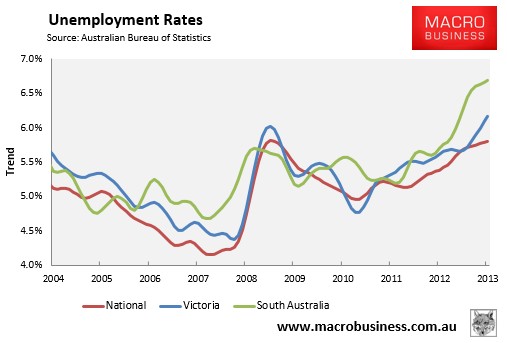
While the timing of the exit will be important and new growth drivers will emerge over time, for the next few years at least both states are facing their darkest period since the early-1990s recession.
