

Roy Morgan Research (RMR) has released two surveys today pointing to weakness in the Australian economy.
First up, RMR’s unemployment estimate for the month of January registered a small rise in the unemployment rate to 11.3% from 11.2% in December (see next chart).

It was the highest unemployment rate recorded by RMR since January 1995.
According to Gary Morgan:
Australian unemployment has increased substantially over the last 12 months to now be at a record high 1.440 million (up 113,000 since January 2013). In addition there are now 1.105 million (up 37,000 in a year) under-employed Australians – a record high total of 2.545 million Australians (20.0%) either unemployed or under-employed.
“Our Federal Parliamentarians are due to finally return to work next week after their Summer break and clearly their number one priority must be reducing the high level of unemployment and under-employment in the Australian economy”.
As explained previously, RMR measures employment differently from the ABS:
According to the ABS definition, a person who has worked for one hour or more for payment or someone who has worked without pay in a family business, is considered employed regardless of whether they consider themselves employed or not.
The ABS definition also details that if a respondent is not actively looking for work (ie: applying for work, answering job advertisements, being registered with Centre-link or tendering for work), they are not considered to be unemployed.
The Roy Morgan survey, in contrast, defines any respondent who is not employed full or part-time and who is looking for paid employment as being unemployed…
Since Roy Morgan uses a broader definition of unemployment than the ABS, it necessarily reports a higher unemployment figure. In addition, Roy Morgan’s measure tends to be far more volatile, owing to the fact that it draws on a smaller sample than the ABS and is not seasonally adjusted.
Both the official ABS unemployment rate and the unofficial RMR measure tracked each other closely until mid-2010 before diverging sharply (see next chart).

The reasons behind the big divergence between the RMR and ABS unemployment measures since mid-2010 remains a mystery, but probably has something to do with RMR’s picking-up discouraged workers. Because the measure is not seasonally adjusted it also jumps at the end of each year as school leavers hit the jobs market.
In any event, the trend in both surveys suggests that the Australian labour market remains soft, with jobs growth below the level required to soak-up the growing population.
Consumer confidence:
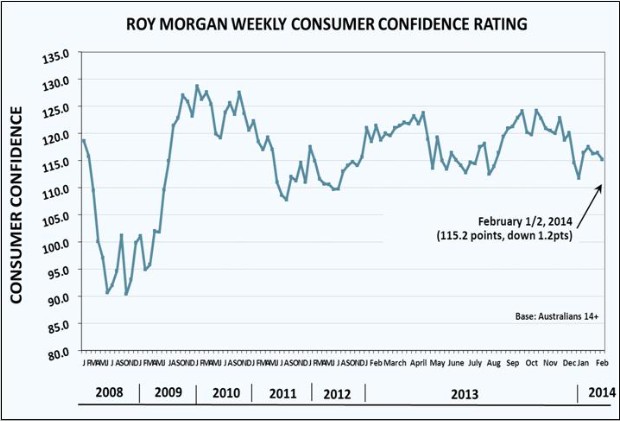
Second up, the RMR weekly consumer confidence index has fallen to its lowest level in 2014.
Over the week ended 1/2 February, the RMR index fell by 1.2 points to 115.2 to be up 3.4 points (3%) from the trough reached in the final week of December, but 3.3pts (2.8%) lower than a year ago (see next chart).
According to Gary Morgan:
“Despite Parliament still being in Summer recess, last week’s decision by the Federal Government to knock back SPC Ardmona’s request for $25 million to help restructure its operations has put the future of the company in some doubt. Parent-company Coca-Cola Amatil is set to make a decision on SPC Ardmona’s future later in February…
It is imperative the Federal Government, which is due to return to work next week, sets out a comprehensive reform agenda to address the growing problem of joblessness in Australia.”
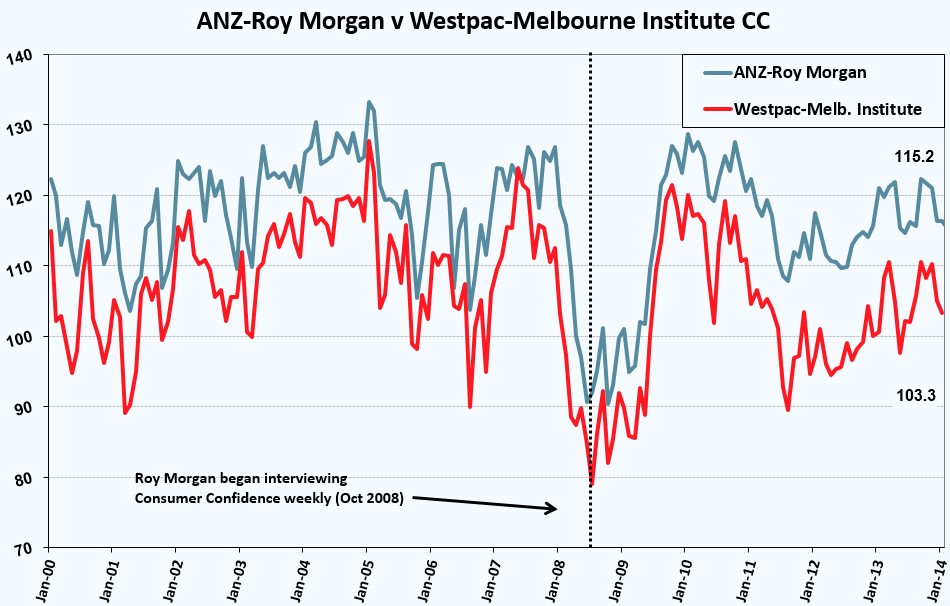
Here’s how the RMR consumer confidence index is now tracking against the monthly Westpac-Melbourne Institute consumer sentiment index, whose most recent reading for January registered a fall:
unconventionaleconomist@hotmail.com
