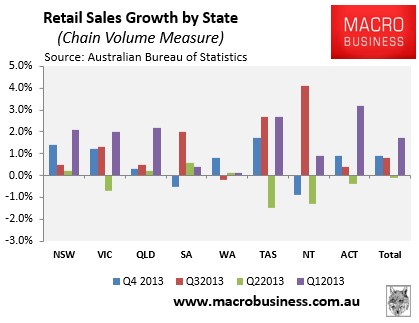
Today’s solid retail sales are set to boost Australia’s December quarter GDP after recording 0.9% growth in real chain volume terms. The overall result was up slightly from the September quarter, where sales volumes rose by 0.8% (see next chart).
Advertisement
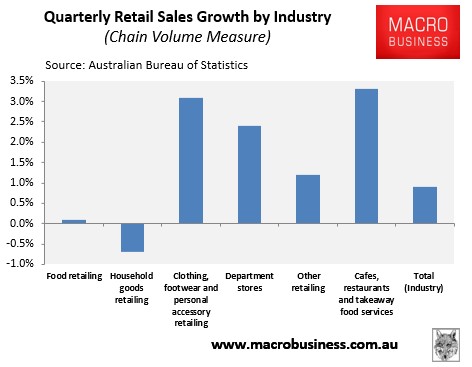
Looking at the breakdown of the key components, you can see that volume rose strongly in the discretionary retail segments, which suggests that goods retailers experienced a solid Christmas (see next chart).
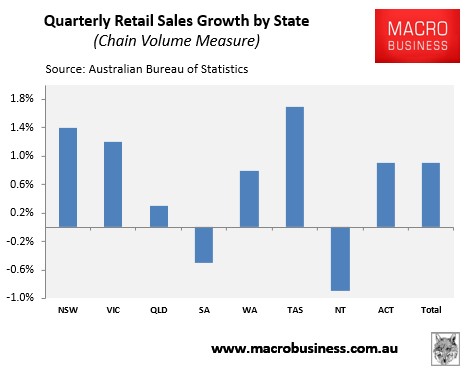
Looking at the states and territories, retail sales volumes over the December quarter rose in all jurisdictions, except South Australia and the Northern Territory:
Advertisement
Retail sales are a sub-component of household consumption, which is itself the largest component in GDP. It is volumes that matter for GDP, so the 0.9% quarterly result, up from 0.8% in the September quarter, will support December quarter GDP growth.
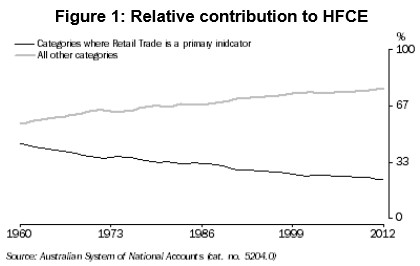
That said, as the ABS was at pains to point out last year that retail’s share of Household Final Consumption Expenditure (HFCE) has fallen significantly over the past 50 years as Australians spend a greater share of their incomes on services:
Advertisement
Historically, Retail Trade estimates contributed 55-60% of HFCE in the expenditure side of Gross Domestic Product (GDP). However, this coverage of HFCE has fallen over time as household expenditure patterns have gradually shifted from goods to services. As a result, Retail Trade now contributes approximately 30% of quarterly estimates of HFCE.
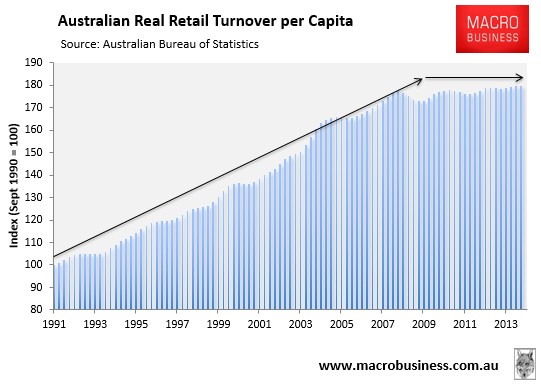
It’s also worth highlighting that when adjusted for both inflation and population growth, retail sales have experienced virtually no growth over the past six years – a big contrast to the stellar growth experienced in the previous 15-year period (see next chart).
Advertisement
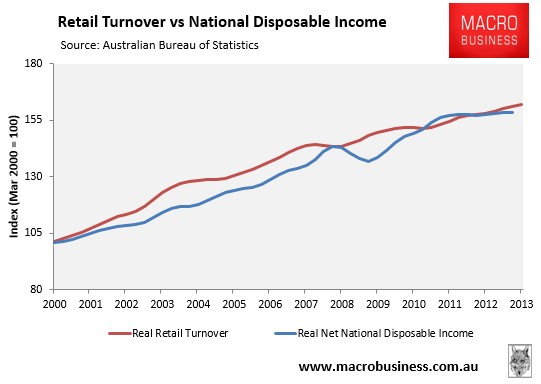
As explained previously, with household savings rates having returned to long-run historical norms and likely to remain there, retail sales growth is likely to grow in line with disposable incomes going forward (with obvious deviations quarter to quarter).
On this point, the next chart is instructive. Despite six years of sluggish retail growth, overall retail sales have still managed to exceed income growth since 2000 – incomes that were highly inflated by the one-off boom in commodity prices (see next chart).
Advertisement
Given that household income growth over the next 10 years is unlikely to grow at anywhere near the pace of the last decade as the joint commodity price and mining investment booms unwind and the population ages (reducing the employment-to-population ratio), the retail sector is likely to experience a continued period of subdued growth and the recent pick-up is likely a cyclical bounce of pent-up demand after the election within a longer-term structural downshift.
Leith van Onselen is Chief Economist at the MB Fund and MB Super. He is also a co-founder of MacroBusiness.
Leith has previously worked at the Australian Treasury, Victorian Treasury and Goldman Sachs.