
Some days you have to wonder who is running the show. Markets everywhere are celebrating the Chinese credit surge and from FTAlphaville comes a series of quotes from prominent China analysts where confusion reigns.
From SocGen’s Wei Yao:
Bank loans were probably the most striking figure in January’s credit data. New bank lending surged to a four- year high of CNY 1.32tn, above expectations (Cons. 1.1tn; SG 1tn). However, this does not seem to suggest a change in the monetary policy stance, just yet. First, bank lending often exceeds CNY 1tn in the first two months. Secondly, according to local news, the big four state banks, under the pressure from the central bank, had to cut back new lending by nearly CNY100bn from CNY 440bn to CNY 350bn during the last week of January. Thirdly, the central bank started to withdraw liquidity from the interbank market as soon as the Chinese New Year holiday ended.
Moreover, total credit growth actually slowed for the tenth consecutive month to a 17-month low of 17.5% yoy from 17.9% yoy previously, despite the seemingly big increase in total social financing. Net corporate bond issuance remained depressingly low at just CNY 33.2bn, compared with over CNY 200bn a year ago. New trust loans nearly halved yoy from CNY206bn to CNY106bn. As more cases of troubled trust products emerge, the downward trend of the trust sector will only intensify. Banker’s acceptance bills increased by CNY 490bn in January – a big monthly number but still smaller yoy. New entrust loans remained the only segment showing yoy acceleration (CNY 396.5bn, the biggest monthly increase ever). However, the banking regulator is reportedly stepping up supervision over this sector.
Hence, we think that the latest credit report do not warrant any change to our view. Credit growth deceleration is still on track, and so economic growth slowdown will most likely intensify from there onwards.
From UBS’s Wang Tao:
Due to last year’s high base, overall credit growth (as measured by TSF excluding equity fund raising) slowed marginally from 18.4%y/y in December to 18%y/y in January (Figure 1). However, from a flow perspective, new credit growth accelerated sequentially, as our credit impulse measure picked up from about 25% to 30% in January on a 3mma basis (Figure 2).
This latest set of data shows that despite recent bouts of liquidity tightening (initiated by the central bank) and increasing market concerns about the sustainability of certain shadow banking products such as trusts, credit growth remains rapid. This may have been because the central bank allowed credit conditions to ease somewhat in January, especially via bank lending, as the government still wants to protect investment and GDP growth and wants only moderately slower credit growth. In hindsight, the PBC’s tightening moves within the interbank market before the CNY were perhaps meant to prevent bank lending from growing at an even faster pace or from spiralling out of control, rather than to aggressively tighten as markets had feared at the time.
For 2014 as a whole, we maintain our forecast that credit growth (measured by TSF excluding equity) will slow moderately to just below 16%, although it start off more robust for the first few months. We are less concerned about a sharp slowdown in credit growth due to aggressive tightening or the continued rise of interest rates, and more concerned about credit volatility triggered by renewed bouts of liquidity squeezes, a tightening of shadow credit regulations, or more importantly, any potential credit defaults in the shadow credit market that could lead to a temporary shrinkage of certain credit markets.
From BoFAML’s Lu Ting:
Market impact could be ambiguous
The rebound in new credit in January was due mainly to seasonality as Chinese lenders usually ramp up lending in the year beginning. Still, we believe most analysts agree that credit growth remained quite robust. Markets’ first instinct could be positive as the January credit data could boost confidence in short term economic growth. However, these data can also raise more concerns on China’s financial system and incoming deleveraging. In this regard, we would like to point out that the abnormally high TSF in January was due partially to some insignificant components such as undiscounted bills and FX loans which lead to a lesser debt burden than other types of conventional credit.
1Q growth could be quite stable despite weak PMI readings
Robust January credit data point to resilient demand. Note the PBoC reportedly gave window guidance to big four banks to prevent too fast credit growth, and new loans at those banks were actually revised down in the last days of January. New medium-to-long-term corporate loans rebounded to RMB504bn in January from RMB30bn in December, suggesting fixed asset investment growth could remain robust (in line with strong commodity import growth data in January).
Now you know the PBoC is not really tightening
Markets have been quite concerned about the PBoC’s monetary/credit tightening and investors’ withdrawal of money from trust products, but the January money/credit data, plus the PBoC’s proactive open market operations, tell us that the PBoC’s policy stance remains neutral.
Here is the data again:
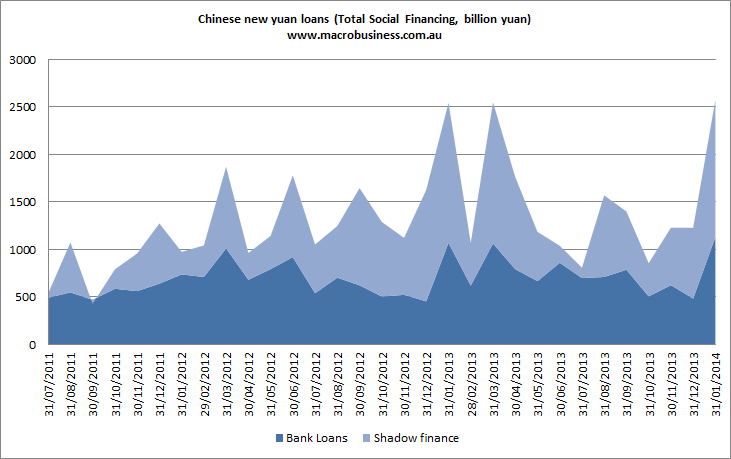
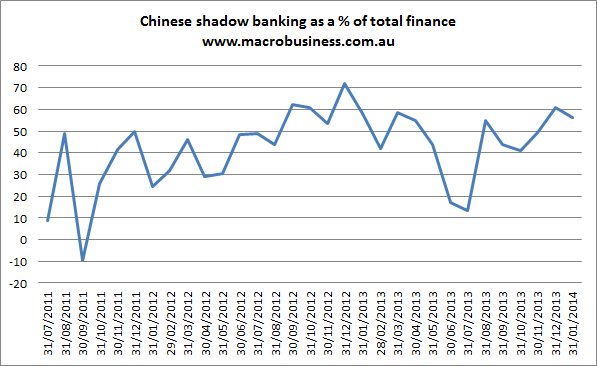
Given the confusion it’s worth repeating a few basic points:
- it’s too early to conclude anything decisive about the impact on Chinese growth. Wait for the next few months of credit;
- however, there are a few home truths we can rely on. Credit growth year over year was 1.4%. It could stay at this level every year and growth would quickly collapse (all things equal). Imagine the economic carnage if Australian credit were growing at 1.4% per annum! It’s rate of change that matters to growth not level;
- it’s very probable therefore that authorities have succeeded in tightening credit. We can see it all over the place in marginal indicators like iron ore and copper which are surging on cash for collateral deals owing to tight finance;
- the relationship between credit and growth in China is slipping, as we saw last year with the big early year surge but relatively little follow through to activity. It is also a prime reason for the reform process China has undertaken. Unless the credit/growth relationship has suddenly improved, today’s data will not deliver any sudden surge in growth. On the contrary, it is consistent with further slowing.
