From Westpac, Bill Evans and his leading index come back to earth:
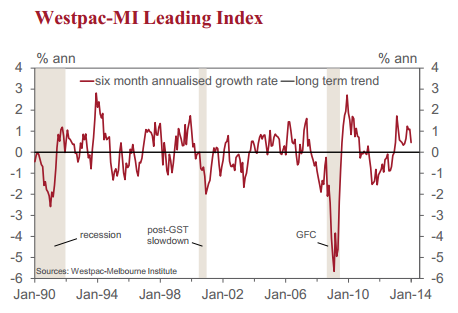
• The six month annualised deviation from trend growth rate of the Westpac Melbourne Institute Leading Index which indicates the likely pace of economic growth three to nine months into the future fell from 1.09% in December to 0.46% in January.
The Index is still indicating above trend growth in the three to nine month window through 2014. However that message has softened in the last few months from the recent above trend peak in October last year of 1.23%. The reading from the Index is now around the average above trend read we saw in the April to September period last year when the deviation above the trend growth rate averaged 0.49%. That followed the 18 month period from mid 2011 when the growth rate was below trend.
As discussed previously the Index is designed to anticipate the endogenous growth trends in the economy and will not be able to capture the effects of large exogenous shocks such as the wind down in the mining investment cycle. Consequently, whereas the Index is still pointing to above trend growth in the April to October ‘window’ in 2014 Westpac is still expecting below trend growth in 2014 of 2.6% and, indeed, an annualised pace of only 2.6% in the June and September quarters.
Of most interest in the January print of the Index has been the somewhat abrupt slowing in the above trend pace since that recent peak in October last year. The ‘above trend pace’ slowed by 77bps from 1.23% to 0.46%. That reduction can be attributed mainly to: the Expectations component of the Westpac Melbourne Institute Index of Consumer Sentiment (39bps); the yield curve (26bps); dwelling approvals (15bps); the Westpac Melbourne Institute Index of Unemployment Expectations (8bps); and the Share Price Index (5bps). Partially offsetting these were improvements in hours worked (9bps) and US industrial production (8bps).
The level of the Index fell by 0.15 points (0.15%) in January. Key contributors to the fall were: the Expectations component of the Westpac Melbourne Institute Index of Consumer Sentiment (down 7.4%); the share price Index (down 3.1%); the Westpac Melbourne Institute Index of Unemployment Expectations Index (up 2.3%); and dwelling approvals (down 2.9%).
The Reserve Bank Board next meets on March 4. In a recent Statement from the Governor he indicated that a period of rate stability would now be appropriate. Consequently there is virtually no chance of a rate move in March. Markets have been unsettled by the surprise lift in inflation in the December quarter and are now pricing in a rate hike by early next year. In its February Statement on Monetary Policy (SoMP) the Bank pointed out that market pricing was indicating a long period of steady rates prior to a hike in early 2015. In making that observation the Bank was probably endorsing that view. With rates on hold, certainly until the second half of 2014, the Reserve Bank’s growth and inflation 19 February 2014 forecasts for 2015 become the key policy indicators. A below trend forecast coupled with a benign inflation outlook would open the door for lower rates while an above trend forecast is likely to signal higher rates. In the February SoMP the Bank forecast growth in 2015 of 2.75% – 4.25% with inflation at 2–3%.
The midpoint of that growth band, 3.5%, is clearly above trend (3–3.25%) and provides further evidence that the Bank expects to be comfortably on hold in 2014. However by indicating such a wide range for its growth forecast it is not ruling out entirely the prospect of lower rates.
Some forces which Westpac sees as threatening the benign above trend growth outlook in 2015 are apparent in some of the
components of the Leading Index that have explained the recent softening in the Index – consumers becoming more nervous about the future; ongoing anxiety around job security; and the prospect of higher rates. Markets are never comfortable with a benign ‘no change’ in rates scenario and may well push the prospect of rate hikes even harder. We are more concerned about the growth outlook and still see the prospect of rate cuts being more likely than the current expected rate hike scenario.
David Llewellyn-Smith is Chief Strategist at the MB Fund and MB Super. David is the founding publisher and editor of MacroBusiness and was the founding publisher and global economy editor of The Diplomat, the Asia Pacific's leading geo-politics and economics portal.
He is also a former gold trader and economic commentator at The Sydney Morning Herald, The Age, the ABC and Business Spectator. He is the co-author of The Great Crash of 2008 with Ross Garnaut and was the editor of the second Garnaut Climate Change Review.