CBA’s senior economist, Michael Blythe, has a piece in the AFR today that argues the Australian dollar is headed back above parity with the US dollar:
Households will continue to save and remain significant net lenders. The change in household behaviour promoting savings was under way before the financial crisis hit. The pick-up in household savings and reduction in borrowing appetite look permanent. Business net borrowing is set to decline. The mining construction boom that drove business funding requirements to exceptionally high levels is ending. Government net borrowing should also decline. The recent mid-year review shows the Commonwealth budget deficit slowly declining over the next 10 years. However, the chances are that the government proceeds further and faster than the baseline projections suggest.
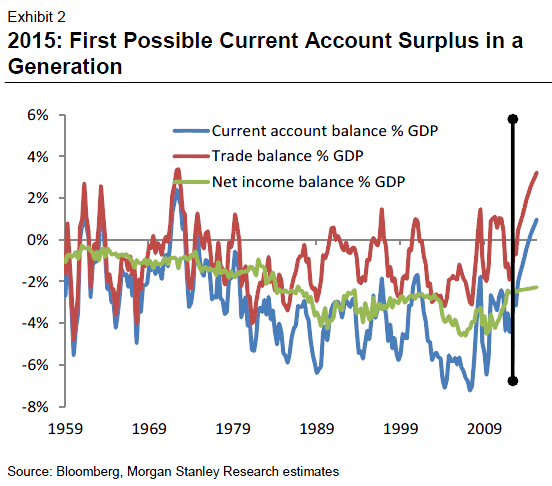
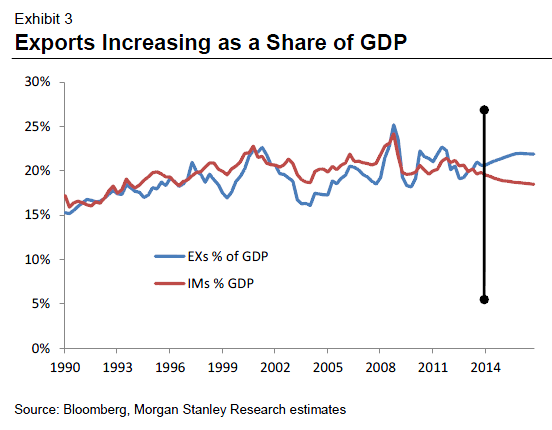
…The expanding middle-income population in Asia should lift demand for Australian services exports such as tourism and education as well. On the income side, the broad macro backdrop suggests payments on our foreign liabilities should grow reasonably slowly. Global interest rates are set to remain low for an extended period. But the expansion of Australian superannuation funds will boost earnings on our foreign assets by more. The net income deficit (Australia’s interest and dividend payments to the rest of the world, less our offshore investment earnings) should narrow as a result. Trade surpluses and smaller income deficits equal current account surplus. Countries that run current account surpluses typically have strong currencies.Examples include Switzerland, Japan and Singapore. The argument is reinforced from the deficit perspective.
This argument is not new. It was put by Morgan Stanley last year:
Advertisement
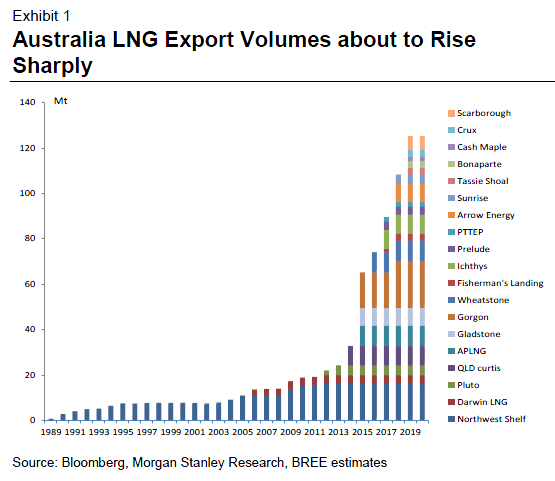
LNG exports from Australia could be the next big thing, in our view. The ramp-up would be enough to see Australia record a current account surplus in 2015, the first since 2Q 1975.
What’s more, with the global market physically unable to create arbitrage opportunities via US shale gas (due to lack of export capacity), the price story for LNG exports remains supportive, with long-term contracts locked in linked to oil prices.
By 2017, Australia may also overtake Qatar as the world’s largest LNG exporter. Also by that time, we believe that Australia’s total energy exports (LNG plus steaming coal) would be as large an export as iron ore.
As I said then:
The calculations behind the CAS are not provided. The swing factor will be domestic demand. For imports to fall away so consistently there’s going to have to be weak consumption growth so this note also implies the argument we’ve been making at MB for some time, that the next few years are going to look much better than they feel if we’re going to get a CAS. It’s always possible to run a CAS. The challenge is can you do it and still be growing?
Another point to note is the same one I made in my recent LNG report, the competitive challenge to Australian LNG arrives in five years, at which time many of the same projects driving the CAS will find themselves at the wrong end of the cost curve, making the surplus temporary.
As well, if you look at the above chart, you will see that most of the volume growth that occurs after 2015 is from projects that do not yet have investment commitment. Ironically, MS is using this as an argument to go long Aussie dollars but if our competitiveness doesn’t improve (including via a lower dollar) then the projects will never get up.
That’s the rub. Blythe’s argument is self-defeating. If he’s right and the currency trades so high then the CAS will smash the very growth sectors that underpin it. In short, we can’t compete at above parity with our cost base. We can’t do it at 90 cents.
Advertisement
CBA’s institutional guys are the most bullish in the marketplace. This is another example.
David Llewellyn-Smith is Chief Strategist at the MB Fund and MB Super. David is the founding publisher and editor of MacroBusiness and was the founding publisher and global economy editor of The Diplomat, the Asia Pacific's leading geo-politics and economics portal.
He is also a former gold trader and economic commentator at The Sydney Morning Herald, The Age, the ABC and Business Spectator. He is the co-author of The Great Crash of 2008 with Ross Garnaut and was the editor of the second Garnaut Climate Change Review.