The IMF has released its annual Australian report card and its roughly right with a modest upgrade in its Australian economic forecasts, predicting 2.6 per cent growth in 2014 and 2.7 per cent in 2015, up from 2.5 per and negligible really. It does not see the economy returning to its long-term trend until 2017.
With GDP growth below trend and the investment phase of the mining boom having passed its peak and beginning to decline, a key issue is how Australia can manage the mining-production/export phase and encourage broader-based growth. The main external risks include a slowdown in China over the medium term and surges in global financial market volatility. The pickup in housing market activity, though welcome to date, could pose a future risk if prices accelerate and lead to overshooting.
Near-term macroeconomic policy mix. With the exchange rate still moderately overvalued and weighing on non-mining activity, accommodative monetary policy remains appropriate.
Monetary policy should remain the primary macroeconomic tool for managing aggregate demand, although there is fiscal policy space to respond in the event of a deterioration in the outlook.
Medium-term fiscal policy. The government’s aim to return the budget to surplus over the medium term would help rebuild fiscal buffers. Staff’s analysis shows that without increases in revenue this would require sizeable cuts in projected spending.
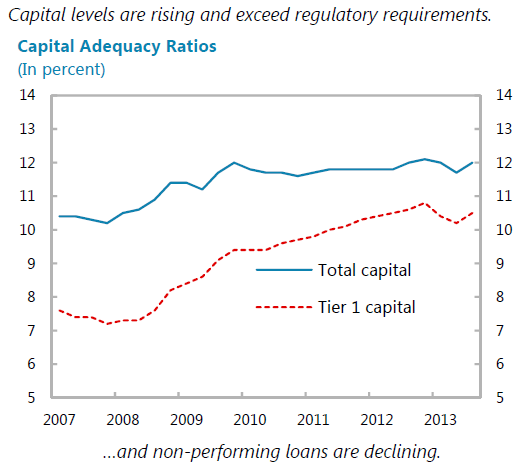
Financial stability. The financial sector is resilient and has strengthened in recent years, although banks’ reliance on offshore funding will continue. The emphasis on tight lending standards and intensive supervision should help limit financial sector risks.
Transition to broader-based growth. Higher resource exports will make the economy more sensitive to terms of trade shocks, and the floating exchange rate will be an essential buffer. Robust income growth over the past decade was supported by the sharp increase in the terms of trade. As this effect unwinds, a significant pickup in productivity will be needed to maintain growth in living standards.
So far so good. However, the bank makes two mistakes. The first is monetary and prudential policy:
10. The authorities have some past experience in moderating a housing boom. The large run up in house prices in the early 2000s followed a period of robust consumption growth and the introduction of more favorable tax treatment for investors, and this was accompanied by rapid credit growth concentrated in investor loans. But this period was not followed by falling house prices, even in real terms—instead house prices leveled off after 2003. Housing market developments were a contributing factor to the RBA’s 2003 increase in interest rates. In 2002/3 the RBA commented that the high rates of house price inflation and credit growth were not sustainable and that borrowers entering the market would be taking on significant risks. 5 APRA called for a more conservative approach to lending practices by banks in late 2002 and sought more information on the extent and nature of exposures. Increased communication about the risks by APRA and the RBA, stricter enforcement of tax claims for rental properties, plus the timing of interest rate hikes appear in retrospect to have helped deliver a cooling of the housing market without a sharp decline in prices.
Advertisement
This is taken out of context. The 2003 episode worked primarily as a soft landing because the terms of trade took off just as the Sydney bubble burst so other cities and activity took up the slack. There’ll be no such good fortune in the next three years as the capex cliff keeps a lid on domestic demand if housing is brought to heal.
The second mistake is to fall for the bank’s bait and switch around capital:
21. Regulatory and supervisory framework. The authorities’ framework seeks to address these financial sector vulnerabilities (Annex 2, paragraphs 11 and 12). Conservative risk weights give Australian banks higher quality capital than most of their advanced country peers.
Advertisement
This one would be funny if it weren’t so dangerous. It’s not possible to make comparisons between Australian bank capital and peers because nobody knows how the Australian bank’s internal risk models work. They are a closely guarded secret held in place by the loopholes in the Basel Committee’s Pillar III disclosures. Moreover, what we do know about the mortgage book is that it operates on extreme leverage (well above 50 x capital) owing to the full use of the the risk weights arising from the opaque models.
Another point of note is the tension that flows from our extended banks to fiscal policy:
14. Fiscal policy. Australia’s fiscal position compares well to its advanced economy peers, although debt has increased in the aftermath of the global financial crisis (Annex 5). The government considers it a priority to return the budget to surplus to preserve its favorable standing with external creditors against the background of relatively high overall net foreign debt (paragraph 23). To this end, the government has announced the broad aim of returning the budget to a sustained surplus, building to a 1 percent of GDP surplus by 2023/24. A more detailed framework will be established when the government announces its fiscal strategy in May. The government has also pledged to scrap the carbon tax and the mineral resource rent tax which will reduce revenue by about ¼ percentage point of GDP compared to total budget revenues from the mining sector of around 2 percent of GDP. Staff supported the broad aim of improving the budget position over the medium term, which would help rebuild fiscal buffers and increase the policy scope to deal with adverse shocks, but cautioned that it should be done in a way that does not disrupt growth prospects in the near term.
Advertisement
In short, a clean budget must protect the banks but overdoing austerity will do more harm than good.
Finally:
24. Exchange rate. Despite some recent depreciation the real exchange rate, currently in the range of 89 cents to the U.S. dollar, is 5-10 percent above the level predicted by Australia-specific factors from a medium-term perspective (Box 2). There are a number of factors contributing to the current high level of the Australian dollar, including the substantial capital inflows to fund the mining sector investment, the gap between domestic and foreign interest rates, and portfolio allocation towards Australian dollar assets by foreign institutional investors. If these factors were to ease, possibly triggered by exit from unconventional monetary policies by major advanced economies, the exchange rate would likely depreciate further, supporting the transition of the economy towards more balanced growth. Budget deficit reduction should help take pressure off the dollar over the medium term by boosting national savings, and additional steps to encourage private saving such as the planned increase in the superannuation contribution rate will also help.
We need (and should have) low 80s, in other words.
Advertisement
A pretty good effort by the IMF this time around. Those expecting any return to trend growth over the medium term take note.
David Llewellyn-Smith is Chief Strategist at the MB Fund and MB Super. David is the founding publisher and editor of MacroBusiness and was the founding publisher and global economy editor of The Diplomat, the Asia Pacific's leading geo-politics and economics portal.
He is also a former gold trader and economic commentator at The Sydney Morning Herald, The Age, the ABC and Business Spectator. He is the co-author of The Great Crash of 2008 with Ross Garnaut and was the editor of the second Garnaut Climate Change Review.