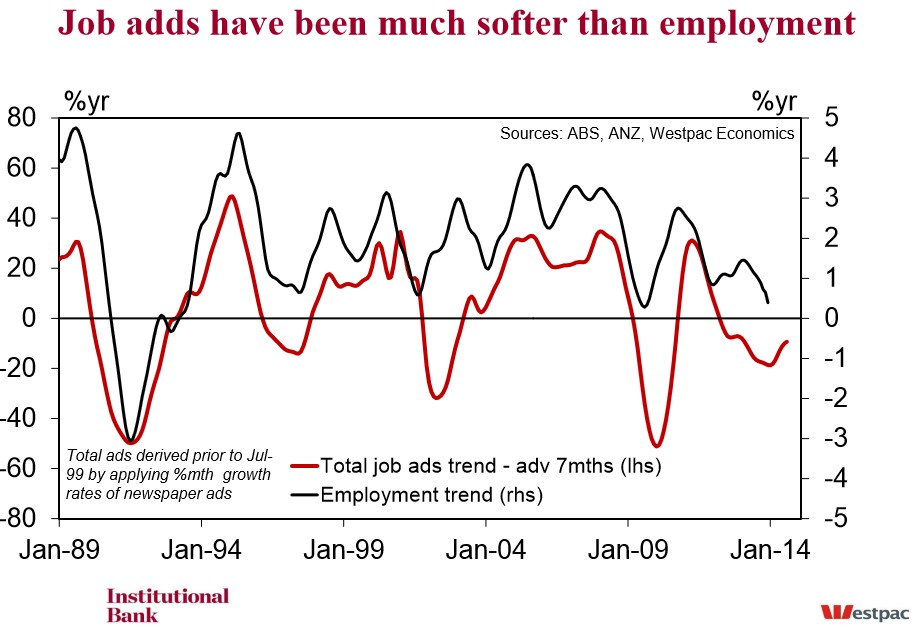
Job advertisements fell a further 0.3% in Jan, following a 0.8% fall in Dec and a 0.9% fall in Nov. We have now seen just two positive prints from job ads in the last 23 months leaving ads some 25% lower than in Feb 2012.
However, the pace of decline in job ads has slowed. They are down around 3% in the last six months and are now 8.9% below year-ago levels, an improvement from –10.3%yr in Nov and –18.8%yr in Jun 2013.
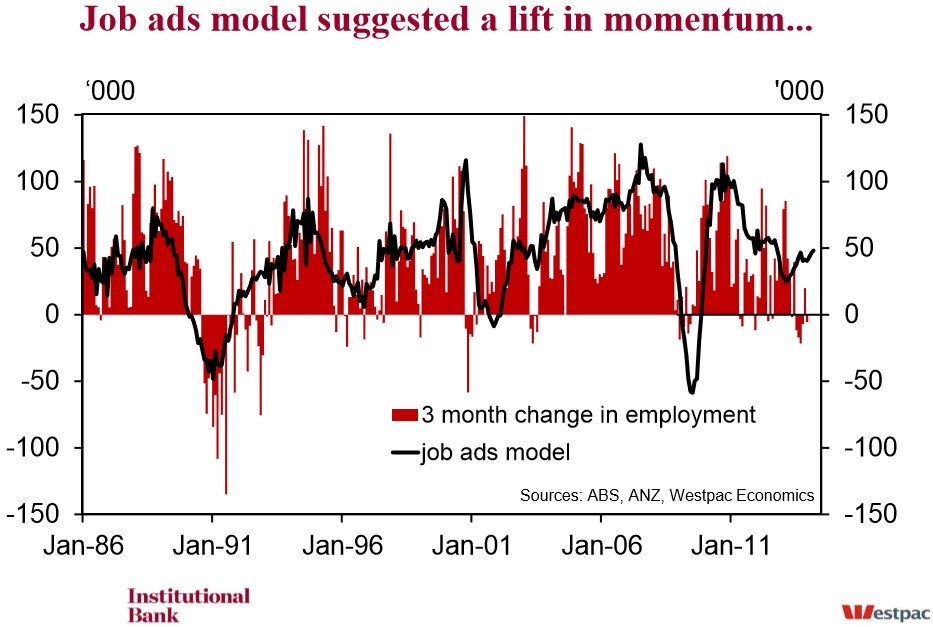
This ongoing moderation in the rate of decline has been appearing in our model of the 3-month change in employment as a more robust outlook for employment. However, there have been large deviations from the model estimates and actual employment outcomes.
Internet job advertisements fell 0.2% in Jan to be down 8.4%yr.
Newspaper ads fell 1.4% in Jan which is somewhat surprising. Nevertheless, the annual pace of decline continues to improve lifting to –22.1%yr from –27.5%yr in Dec and the May low of –39.6%yr.
As Westpac has noted before, there are issues with the ANZ jobs ads series and how they compose the internet series in particular. We thus use job ads very cautiously as a leading indicator of employment. Nevertheless, it is providing a sign of a turnaround in labour demand which is something to watch closely.
In particular we note the improvement in the annual change in the deviation from trend of newspaper ads. This second derivative of newspaper ads abstracts from the trend decline in this series and has been a handy indicator of turning points. Moving above zero has, in the past, been a signal for stronger employment growth 3 to 7 months out. This series printed +1.3 in Jan.
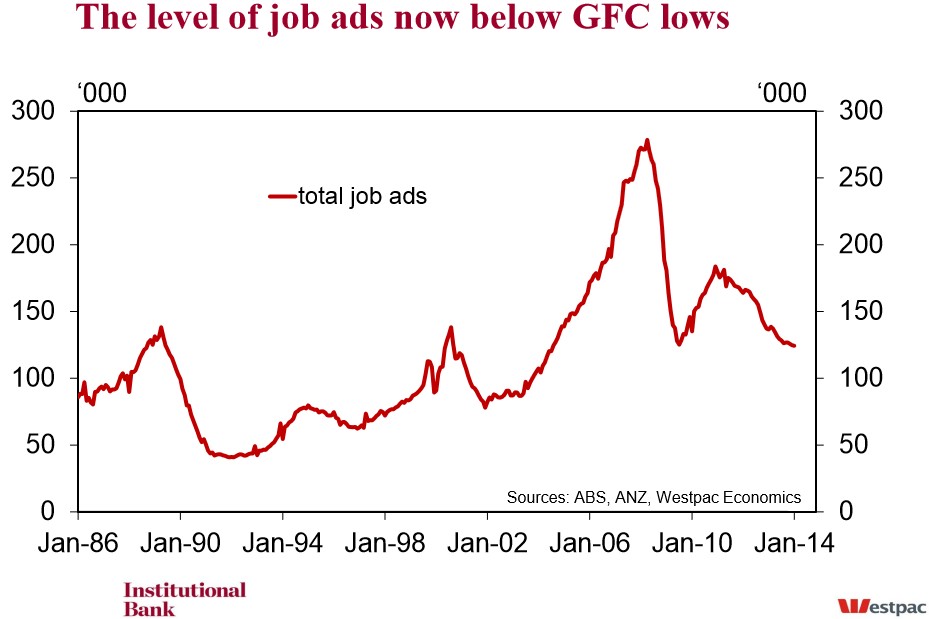
The level of the job ads index continues to highlight that labour demand is still well below the highs of 2008; in fact the level of total job ads is 0.7% below the post GFC low. Firms are still quite reluctant to expand their workforce.
We will be closely job ads over the coming months to see if the early signs stability materialises into an uplift in vacancies and jobs ads.
Leith van Onselen is Chief Economist at the MB Fund and MB Super. He is also a co-founder of MacroBusiness.
Leith has previously worked at the Australian Treasury, Victorian Treasury and Goldman Sachs.