
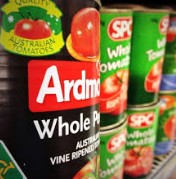
In yesterday’s Media Release by SPC Ardmona, which debunked the Government’s claim that its woes are caused by “overly generous” employee pay arrangements, the company listed the following factors behind its demise [my emphasis]:
…the serious problems that have beset SPCA have not been because of labour costs and certainly not from the allowances, a fact borne out by the Productivity Commission’s recent analysis. “The business has been severely damaged in recent times by a ‘perfect storm’ created by external economic factors – the high Australian dollar, which appreciated more than 50% from 2009 to 2013, has both enabled the flood of cheap imported product to be sold in Australia below the cost of production here, and also decimated the company’s export markets. “In that period market share of private label canned fruit grew to 58% today, while SPC Ardmona canned fruit share declined to 33%. Our export market volumes declined by 90% in the past five years.
“The other major factors not of our making have been the dumping of cheap imported fruit and vegetable products into the Australian market from countries which do not have anything like the stringent safety, labour and environmental standards as we do; and the fact there are no, or very low tariffs imposed on imported fruit products from countries such as China and the EU while these same countries impose tariffs of up to 20% on average on SPC Ardmona products into their markets.
“We rely on the farming community for our fruit and vegetables and in recent years our growers have been hit by adverse weather conditions including frosts, drought and floods.
“Also, foreign competitors have been dumping their products in Australia and Australia has not been aggressively stamping this out – as New Zealand has done.
“We have also seen examples of imported Chinese-produced and processed fruit carrying lead levels which are twice the allowable standards in Australia – how do these products get into our markets without being tested and banned?”
While many might dismiss these concerns as a just another company seeking protection in order to cover-up its inefficiency, SPC Ardmona’s claims have received support from Australia’s Anti-Dumping Commission, which yesterday found that Italian tomatoes had been “dumped” – i.e. sold at a price below its “normal value” – and had caused “material injury” to SPC Ardmona’s sales and profits:
The Anti-Dumping Commission (the Commission) has found that prepared or preserved tomatoes exported from Italy were exported at dumped prices during the investigation period, the volumes of dumped goods were not negligible and that those exports caused material injury to the Australian industry.
The fact is, many countries exporting food to Australia offer their growers large agricultural subsidies (e.g. EU nations and the US), causing over-production, lowering prices, and increasing import competition for SPC Ardmona.
SPC Ardmona’s concerns about the health and safety standards of countries exporting to Australia is also warranted. Imports of cheap Chinese food have grown significantly in recent years, yet there are big question marks over their quality, with multiple cases cited of Chinese food being polluted by heavy chemicals and substitutes (for example, see here). Not having to comply with as strict standards obviously gives China’s food exporters a cost advantage over SPC Ardmona – an advantage that is compounded by weak country-of-origin labeling laws in Australia, which makes Chinese food difficult to identify.
While Treasurer Joe Hockey has today dismissed the $25 million of structural assistance to SPC Ardmona on the basis that it “must compete in the open market place” – a view I agree with in principle – the fact remains that many other nations do not compete by the same “open market” rules. Even so, the SPC restructuring does appear to make the business viable, as well as save the tax-payer money in the long run.
This is why running such a hard line on assistance to SPC Ardmona – at the same time as the Coalition dishes out subsidies to producers in Tasmania – is dangerous. Australia risks losing its last fruit and vegetable cannery, which would not only decimate the Goulburn Valley Region, but also leave Australians with no choice but to consume imports of dubious quality or from nations that do not compete by the same rules.
