

Roy Morgan Research (RMR) last night released its unemployment estimate for the month of December, which registered a sharp seasonal rise in the unemployment rate to 11.2% from 10.2% in November (see next chart).
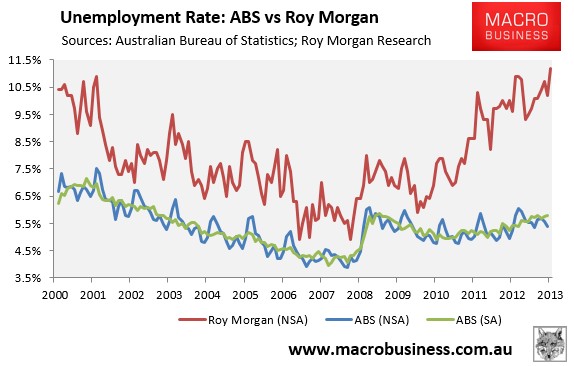
It was the highest unemployment rate recorded by RMR since January 1995.
According to Gary Morgan:
“Australian unemployment has surged to a record high 1.411 million Australians (11.2%, up 1.0%) in December. This is also the highest rate of unemployment in nearly 20 years – since January 1995 (11.3%, 989,000). The rise in unemployment was driven by a large increase in the size of the Australian workforce (12,635,000, up 181,000) – with not enough jobs created in December. Full-time employment dropped to 7,395,000 (down 75,000) – the lowest full-time employment in nearly a year since January 2013 (7,196,000) while the strong rise in part-time employment (3,829,000, up 113,000) wasn’t enough to soak up the new job-seekers entering the workforce…
“Australia’s high level of unemployment and under-employment should be a huge concern for the Coalition Government which has got off to a slow start in the first few months since winning the Federal Election in early September. Today’s first Morgan Poll for 2014 shows the ALP (52.5%) maintaining a clear lead over the L-NP (47.5%) as we enter the New Year. For the Abbott Government to stand any chance of being re-elected in two years significant labour market reforms must be undertaken to remove red tape introduced under the previous Government which will allow Australian businesses to increase hiring.
“Although it must be noted that unemployment traditionally rises in December (in 16 out of the last 20 years), the large drop in full-time employment is a significant concern as it indicates businesses are hesitant about taking on full-time employees. Although Federal Parliament is not due to resume sitting until mid-February, it is imperative that Treasurer Joe Hockey and Minister for Employment Eric Abetz in particular present Parliament with a clear ‘road-map’ to tackle Australia’s high level of unemployment and under-employment – now above 2 million for two straight years since December 2011.”
As explained previously, RMR measures employment differently from the ABS:
According to the ABS definition, a person who has worked for one hour or more for payment or someone who has worked without pay in a family business, is considered employed regardless of whether they consider themselves employed or not.
The ABS definition also details that if a respondent is not actively looking for work (ie: applying for work, answering job advertisements, being registered with Centre-link or tendering for work), they are not considered to be unemployed.
The Roy Morgan survey, in contrast, defines any respondent who is not employed full or part-time and who is looking for paid employment as being unemployed…
Since Roy Morgan uses a broader definition of unemployment than the ABS, it necessarily reports a higher unemployment figure. In addition, Roy Morgan’s measure tends to be far more volatile, owing to the fact that it draws on a smaller sample than the ABS and is not seasonally adjusted.
Both the official ABS unemployment rate and the unofficial RMR measure tracked each other closely until mid-2010 before diverging sharply (see next chart).
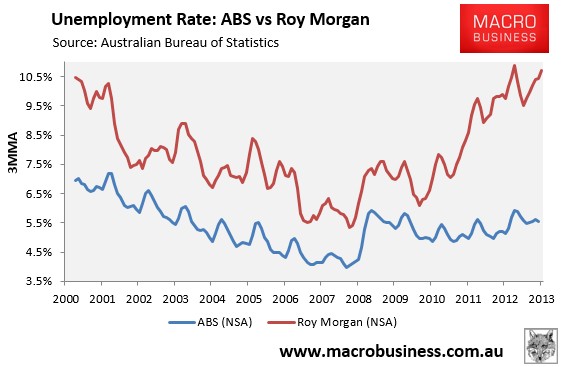
The reasons behind the big divergence between the RMR and ABS unemployment measures since mid-2010 remains a mystery, but probably has something to do with RMR’s picking-up discouraged workers. Because the measure is not seasonally adjusted it also jumps at the end of each year as school leavers hit the jobs market.
In any event, the trend in both surveys suggests that the Australian labour market remains soft, with jobs growth below the level required to soak-up the growing population.
unconventionaleconomist@hotmail.com
