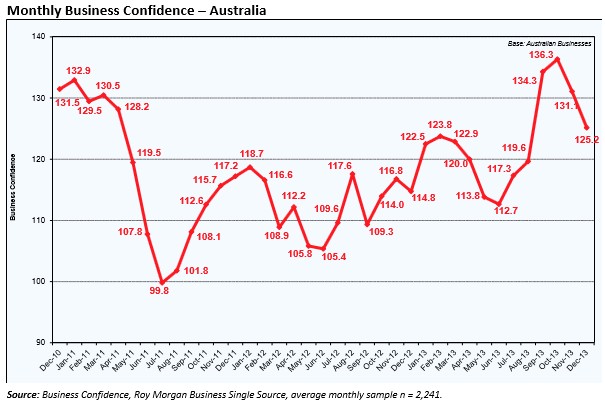
Roy Morgan Research has just released its business confidence index for December, which registered its second consecutive monthly fall:
Roy Morgan Research’s latest Business Confidence survey in December 2013 has fallen sharply from its immediate post-election peak of 136.3 in October to 125.2. This turnaround was expected to some degree after the election but a number of negative events since have contributed to a more severe drop than was considered likely. These December figures are the results of 1,841 interviews across all industries, business sizes and locations across Australia.
The further drop in confidence among business in December was caused by a decline in positive feelings about where the economy is heading in the next 12 months and the next five years. There has also been a small drop in the proportion of businesses considering that the next 12 months are a good time to invest in growing the business.
This decline in Business Confidence in December was across micro business down 6.1 points to 123.3, small business down 6.0 points to 137.3, but medium/large business were steady (up 0.2 points to 147.1). Medium/large businesses (turnover $5m+ p.a.) have clearly been the most confident over the last three years and in December, they remain at a historically high level – and well above their smaller counterparts.
All states except WA have suffered some loss in business confidence during December, with the biggest losses being in NSW and Vic. The most positive is WA, currently on 138.3, followed by Queensland (131.2). The states with below average business confidence are Tasmania (112.2), Victoria (118.8) and NSW (123.5).
Of the major industries, Mining still leads confidence in December with 160.7 (up from 149.7 in November), Retail is around average with 123.0 (down from 131.0 in November) and Construction is on 126.4 (down from 127.9 in November). The agricultural sector remains well below average with 119.4, down slightly on the 121.9 recorded in November.
Norman Morris, Industry Communications Director, Roy Morgan Research, says:
“The further decline in business confidence in December which followed the November fall was probably to be expected to some extent as market realities hit after the highs in September and October created by the election…
“The December fall in confidence was impacted by a number of major negative factors including Holden announcing it was closing its Australian manufacturing plant at the end of 2017, large-scale retrenchments at Qantas and a $47 billion deficit presented by Treasurer Joe Hockey in the Mid-Year Economic and Fiscal Outlook.
“During the first half of December, the ASX 200 declined by 5 percentage points, which was obviously a reflection of some negative feelings regarding the Australian economy, and although it recovered in the second half of December it demonstrated the uncertainty in the market.
“Despite these negative impacts, the level of business confidence in Australia remains above the average seen over the last three years and is above the level of December 2012.”
Leith van Onselen is Chief Economist at the MB Fund and MB Super. He is also a co-founder of MacroBusiness.
Leith has previously worked at the Australian Treasury, Victorian Treasury and Goldman Sachs.