It’s a very different first NAB Survey for the year:
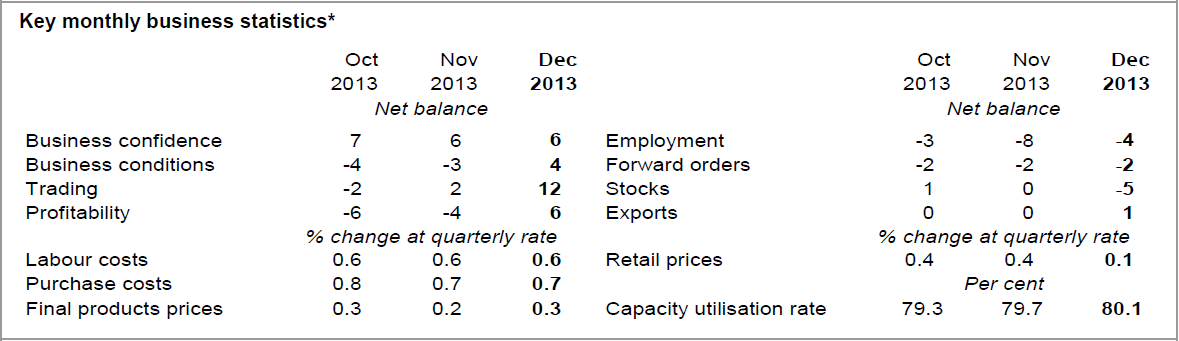
Are we at a turning point? Business conditions jump to more than 2½ year high, while confidence broadly unchanged – both now near trend levels. Sales and profits up sharply – especially in wholesale, transport and services – reducing excess capacity slightly. Employment index better, but still imply flat job market. Soft forward indicators question the sustainability of the lift in conditions. Price inflation still moderate with margins under pressure as AUD increases input costs. Unemployment key to rate outlook. Domestic and global forecasts largely unchanged. But better near term business conditions and the CPI spike delays next RBA cut from May to late 2014.
Business confidence was broadly unchanged in December and is consistent with long run average levels. Confidence has remained surprisingly elevated following the post-election jump, and could potentially remain at these levels for longer than previously thought given that the conditions index has begun to respond. Confidence appears relatively even across industries and the mainland states (unlike conditions).
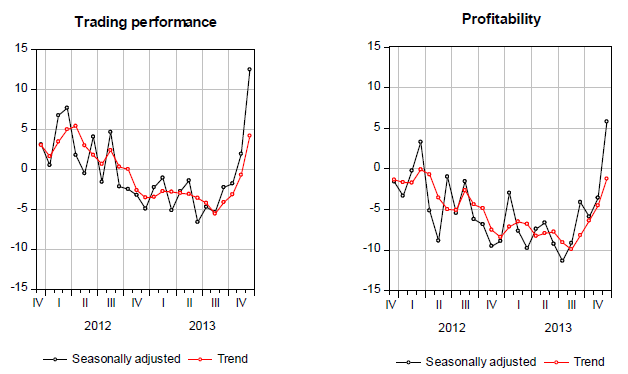
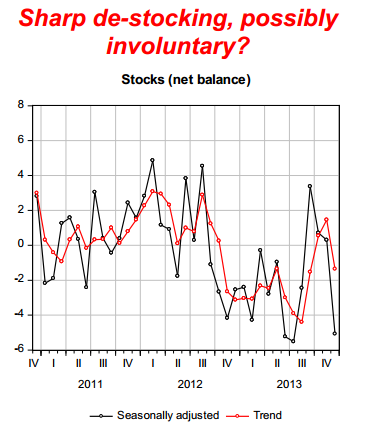
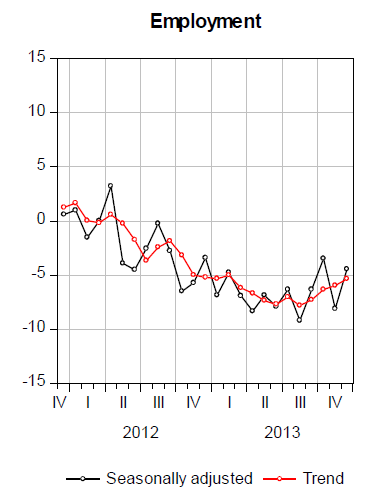
Business conditions jumped in December (up 7 points to +4 index points), moving more into line with confidence. Most industries recorded improved conditions for December – especially transport, wholesale and the services industries more generally – but, manufacturing and construction were both notable exceptions. The sustainability of the jump may be questionable given subdued forward orders, a run down in stocks (although this may be involuntary), and still low capacity utilisation. Employment conditions remain soft (-4 index points). Clearly the January reading (post seasonality) will give a better read on the growth momentum.
Our wholesale leading indicator suggests much weaker underlying conditions and suggests below trend growth continuing into the first quarter of 2014. Against that the improving trend in business conditions suggest a more optimistic outlook – implying underlying demand growth and GDP growth (6-monthly annualised) of around 3% in Q4, above our forecast.
Labour costs growth has held steady at restrained levels, consistent with increasing slack in the labour market. Similarly, subdued purchase costs have kept overall prices growth modest.
The internals look half good:
It’s being driven by leisure, wholesale and retail (ie the consumer):
Advertisement
Business conditions by industry. Conditions improved noticeably for transport & utilities (up 16 points), supported by solid improvements in the wholesale and (to a lesser extent) retail sectors (up 12 and 6 points respectively). Conditions in personal and recreational services have risen to very strong levels (+21 points). In contrast, the manufacturing sectors malaise deepened in December following 4 consecutive months of improvement (down 4 points to -11 index points). Manufacturers are yet to see any material benefit from falls in the AUD, while many are facing higher purchasing costs as a result. The construction and mining industries showed little to no improvement in the month, despite healthy activity in residential property markets and robust commodity demand from China. Recreation and personal services continue to outperform other sectors by a considerable margin (followed by finance/ business/ property firms). The lower AUD may be helping to promote domestic travel and other services (although raising imported energy costs), but these sectors have also proven to be much more resilient to external headwinds in recent years. Overall, conditions remain extremely weak in manufacturing (-11), construction (-11), and to a lesser extent retail and mining (both -4).
So, pretty much what I expected (if a little stronger) with firm Christmas trade (helped by early discounting) hitting some lean businesses and causing this:
Advertisement
In short, house prices have us all spending again. There may be another benefit too as inventories have fallen sharply, perhaps because demand has rebounded more quickly, meaning a restock will be ahead:
So far so good!
Advertisement
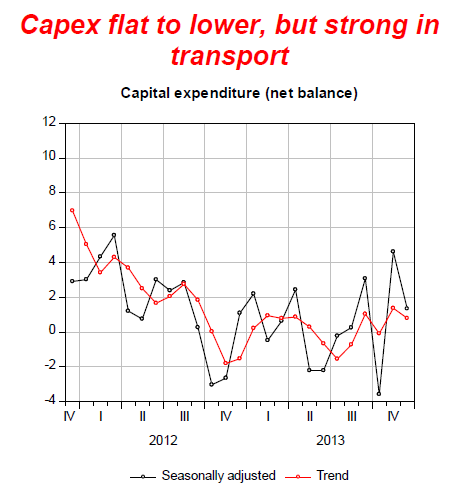
BUT, yes there’s a but, I expect this Christmas flush to pass. It’s got some pent up demand in it but is not and will not translate into much investment and jobs growth as the capex cliff steepens and house prices slow later this year:
This is a positive report for the rebalancing enthusiasts and in a normal cycle it would signal game on for cyclical earnings and rate rises; a solid first half is possible. But this is not a normal cycle and I still expect conditions to deteriorate as the capex cliff steepens through the year.
Advertisement
The dollar liked the report, up half a cent to the mid 87s.
David Llewellyn-Smith is Chief Strategist at the MB Fund and MB Super. David is the founding publisher and editor of MacroBusiness and was the founding publisher and global economy editor of The Diplomat, the Asia Pacific's leading geo-politics and economics portal.
He is also a former gold trader and economic commentator at The Sydney Morning Herald, The Age, the ABC and Business Spectator. He is the co-author of The Great Crash of 2008 with Ross Garnaut and was the editor of the second Garnaut Climate Change Review.