
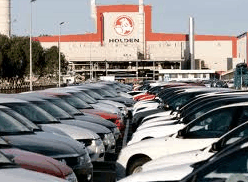
The postmortem on General Motors (GM) Holden’s departure from local operations has continued, with GM’s head of international operations, Stefan Jacoby, explaining that it has become uneconomic to produce cars in Australia, irrespective of the level of government assistance:
“I initiated this decision as the leader of these markets and it was driven purely by business rationale, and not by any direction this government or any future government would give for their auto industry in Australia,” he said.
The sums could not add up regardless of the level of public funds involved, he said.
“Local production, even if it would be pure assembly, really doesn’t make any sense.
“Our automotive business is driven by scale – of economics, of productivity, of an efficient supply industry, of sufficient and efficient and optimised logistics.”
“That means the automotive industry will be focused only on core markets, as it is today. Australia is just too small”…
“In a market of 1.1 million vehicles, in a country that is clearly declaring free trade as one of their policies long term, in a country where every month one of the suppliers is quitting the business – even if you assemble in Australia, your true local content is getting less and less,” Mr Jacoby said.
“So you have 10-15 per cent of locally produced vehicles, with a decreasing local content and with an increasing logistic behind it – so forget all the government and what you have in mind that could trigger us, that was not the case.
“Just see these rationales and Australian manufacturing does not make sense.
Nevertheless, the timing of the closure (in addition to Ford’s) is unfortunate, since it will likely coincide with the sharp unwinding of the once-in-a-century mining investment boom.
Already, there are grave concerns about the impact of Holden’s closure on the South Australian economy, with the state Economic Development Board warning that South Australia faces recession unless decisive policy action is taken.
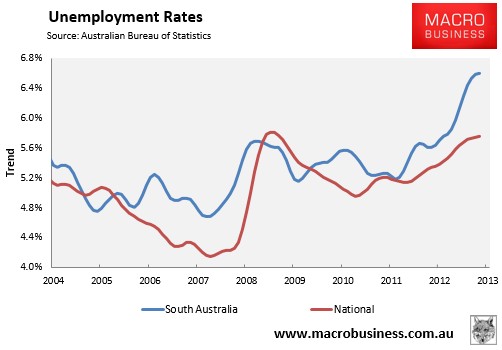
Certainly, recent labour force statistics are not encouraging, with data published by the Australian Bureau of Statistics already showing that the employment situation in South Australia has deteriorated sharply (see next chart).
More worryingly, South Australia has experienced the mainland’s sharpest falls in the number of full-time jobs and the aggregate number of hours worked, which is even more indicative of the state’s labour market weakness (see below charts).
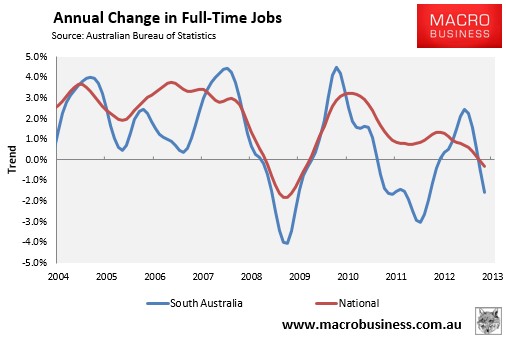
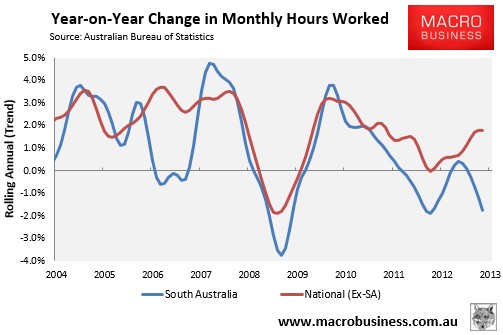
Clearly, South Australia (and to a lesser extent Victoria) will be under the gun from Holden’s and Ford’s departures.
unconventionaleconomist@hotmail.com
