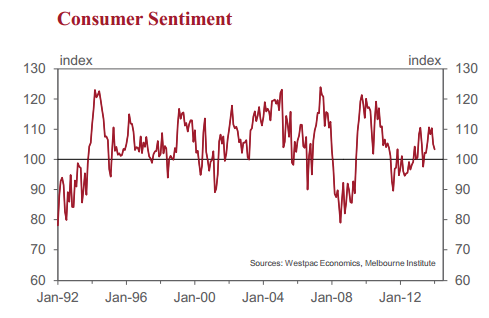
The Westpac–Melbourne Institute Index of Consumer Sentiment fell by 1.7% in January from 105.0 in December to 103.3 in January.
The Index is now at its lowest level since July 2013 and is 6.6% below the recent peak in September last year. Nevertheless the Index remains comfortably in the zone where optimists outnumber pessimists.
The survey was conducted in the week 13 – 18 January when a significant proportion of respondents would have been on holiday.
Typically the January survey shows a strong seasonal upward bias because of the ‘holiday effect’ and seasonal adjustment is important to gauge the underlying strength of the Index.
For example, over the last 5 years on a seasonally unadjusted basis the Index has risen by an average of 5% in January. The unadjusted lift in January 2014 was a comparatively modest 2.5% emphasising the softish nature of the result.
Reflecting this ‘holiday’ atmosphere it is unlikely that particular news items would have been major influences on the Index.
Of course, to the extent that respondents were aware of the announcements, the most important economic event was the release of the December jobs report which showed a shock loss of 22,600 jobs in the month. This concern around jobs is confirmed with our sub-index on unemployment expectations.
There is also some evidence of a cooling in optimism around housing and house prices.
All five components (seasonally adjusted) of the Index fell in January. There were 2.4% and 2.5% falls respectively in the subindexes tracking views on ‘family finances versus a year ago’ and ‘family finances the next 12 months’. Over the last year the ‘family finances vs a year ago’ sub-index has increased by 14.9% but respondents are not confident this improvement will be sustained with the ‘family finances over the next 12 months’ subindex
falling 2.2% in the last 12 months.
The sub-indexes tracking expectations for ‘economic conditions next 12 months’ and ‘economic conditions next 5 years’ fell by 0.5% and 3.2% respectively. Over the last year these components have been relatively steady (1.4% and –0.7% respectively). The sub-index tracking views on “time to buy a major household item” fell by 0.3% to be up a modest 2.4% for the year.
As discussed, the Westpac Melbourne Institute Index of Unemployment Expectations increased by 0.7% following a 4.6% jump in December. Higher readings mean more consumers expect unemployment to rise in the year ahead. The Index shows no signs that respondents are feeling any relief for job prospects despite the Reserve Bank’s rate cuts and the recent fall in the Australian dollar. In January, the Index is 3.5% above its average level in 2013.
Exuberance around the housing market has subsided. Our index tracking views on ‘time to buy a dwelling’ was steady in January but is down 10.5% from its peak in March 2013. We also saw a fall in the House Price Expectations Index of 2.2% although it remains 29% above its level a year ago.
The Reserve Bank Board meets on February 4. Amidst improving optimism around the world economy and clear evidence that both house prices and housing activity are responding to the low interest rates, the Board is certain to hold rates steady. Westpac still sees a case for lower rates later in the year. Evidence from this survey that households are losing a little confidence; the labour market remains very difficult; and the confidence boost around housing may be peaking is all consistent with the eventual need for further relief. But, for now, rates are likely to be on hold for some months.
David Llewellyn-Smith is Chief Strategist at the MB Fund and MB Super. David is the founding publisher and editor of MacroBusiness and was the founding publisher and global economy editor of The Diplomat, the Asia Pacific's leading geo-politics and economics portal.
He is also a former gold trader and economic commentator at The Sydney Morning Herald, The Age, the ABC and Business Spectator. He is the co-author of The Great Crash of 2008 with Ross Garnaut and was the editor of the second Garnaut Climate Change Review.