
Last year, the Washington Post published an interesting article showing the huge growth of coal consumption in China, which has grown so much that China is now burning nearly as much coal as the rest of the world combined (see next chart).
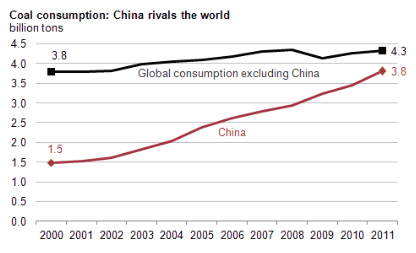
While the growth in Chinese coal use has been hugely beneficial for Australia’s coal exporters in Queensland and New South Wales, it is presenting a problem for global greenhouse gas emissions, which have soared in recent years despite the reduction of coal use (and carbon emissions) in the United States and Europe.
The increased coal consumption in China is also causing major pollution problems domestically. In late-January and early-February last year, pollution levels in Beijing reportedly measured 40 times recommended safe levels, according to The Atlantic. This prompted China’s authorities to undertake short-term mitigation measures, such as shutting down some factories and limiting auto usage.
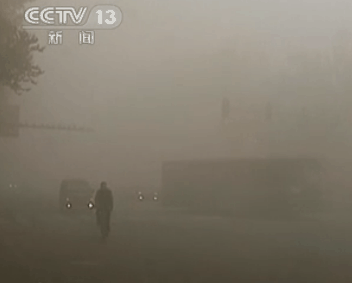
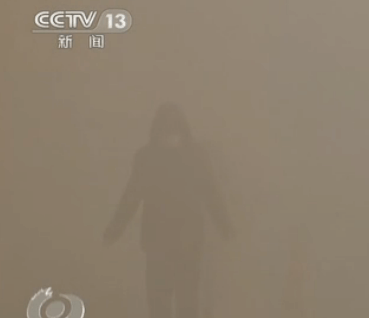
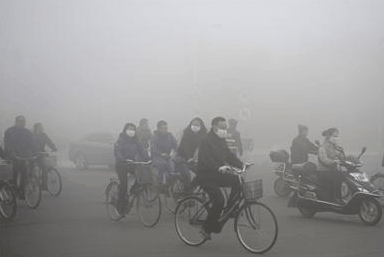
Then in October 2013, a fresh smog outbreak occured in China’s northeastern city of Harbin in Heilongjiang province, where pollution levels were so bad that visibility was reduced to only 10 metres, prompting the local government to suspend school, shut the airport and some public bus routes.
The photos below, which came from China Television, showed just how bad the situation had become in Harbin:
Now a fresh smog outbreak has occurred once again in Beijing, with pollution levels hitting 671 micrograms per cubic meter on Thursday morning at a monitoring post at the U.S. Embassy in Beijing – 26 times the 25 micrograms considered safe by the World Health Organization, and the highest reading since January 2013!
In fact, the smog has become so thick in Beijing that the city’s residents have begun flocking to huge digital commercial television screens across the city to observe virtual sunrises, according to the New Zealand Herald (see below picture).
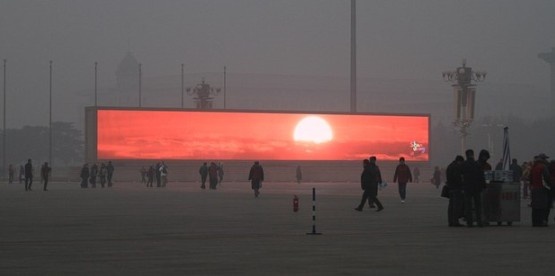
The futuristic screens installed in the Chinese capital usually advertize tourist destinations, but as the season’s first wave of extremely dangerous smog hit – residents donned air masks and left their homes to watch the only place where the sun would hail over the horizon that morning.
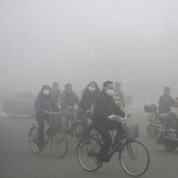
Commuters across Beijing found themselves cloaked in a thick, gray haze on Thursday as air pollution monitors issued a severe air warning and ordered the elderly and school children to stay indoors until the quality improved.
The air took on an acrid odor, and many of the city’s commuters wore industrial strength face masks as they hurried to work.
‘I couldn’t see the tall buildings across the street this morning,’ said a traffic coordinator at a busy Beijing intersection who gave only his surname, Zhang. ‘The smog has gotten worse in the last two to three years. I often cough, and my nose is always irritated. But what can you do? I drink more water to help my body discharge the toxins.’
Perhaps little wonder, then, why so many wealthy Chinese are looking to emigrate to greener pastures in Australia, New Zealand, Canada, and the US (among other places). And who could blame them.
unconventionaleconomist@hotmail.com
