A bunch of bank reports on today’s weak employment data have hit my inbox, which reveal diverging attitudes towards the Australian labour market and economy.
As is often the case, Commsec’s chief economist, Craig James, has taken a bullish view, playing down the result as being backward looking, whilst playing-up the strength in the housing market and rising confidence:
First and foremost it should be said that the unemployment figures are largely backward looking, highlighting the sluggishness in the broader economy in the lead up to and just after the election last year. More timely figures on consumer and business confidence, retail sales, lending finance and housing activity have been more upbeat suggesting that activity levels have firmed over recent weeks.
There is no doubt that over most of 2013 trading conditions were tough for businesses and as a result employers were not keen to take on additional staff. The pickup in in consumer and business confidence is translating into more activity. The $64 question is how quickly does this turnaround the labour market?
While employers are not out there significantly firing workers they are not adding to the workforce. Rather businesses have been in a holding pattern, awaiting an improvement in conditions and managing staff hours…
The pickup in consumer and business confidence has started to translate into more activity. And in turn it will take a few more months to translate to improve business profitability and result in a lift in hiring. The latest results are more of a snapshot on how the economy looked 4-5 months ago. Clearly it takes time to take on new staff, from the start of the interviewing process to when the new starters finally commence work. But given the fact that the economy is crawling off a low base while also trying to adjust to the structural imbalances from the pullback in mining investment, it is likely the jobless rate will probably edge towards 6.0 per cent over the next few months.
While the Reserve Bank would be disappointed and concerned with the sluggishness in the labour market, policymakers would have to be pleased at the way the overall economic recovery is panning out. The housing recovery continues to gather momentum, while rising wealth levels is supporting confidence and in turn spending. In addition the lower Australian dollar should provide a boost to exports in coming months and help to alleviate the risks surrounding the rebalancing of the economy. The key area of concern is likely to be how quickly the labour market recovers. As such we expect the Reserve Bank to maintain an easing bias over the next few months, but further rate cuts are unlikely to be required. Cash rates have probably bottomed.
At the other end of the spectrum, Westpac’s Justin Smirk has taken a more sombre view, highlighting the clear weakness of the Australian labour market:
Westpac was looking for a statistical correction (–10k) from the 21k (original) print in Nov. The Dec Labour Force release did not disappoint us and in fact even went further printing –22.6k. The market had been looking for +10k.
The unemployment rate printed flat at 5.8%. However, at two decimal places it rose from 5.77% to 5.85%. Had it not been for the dip in the participation rate to 64.6%, the lowest since Feb 2005, the unemployment rate would have risen to 6.1%.
The details were also weak and continue to highlight a labour market that is grinding along as it has done for most of 2013. To date, we have not seen anything to yet suggest that 2014 will be significantly different.
Full-time employment fell 31.6k, part-time employment rose just 9k while hours worked was flat. The hours worked number were very lumpy in late 2013 with the annual pace shifting from 0.6%yr in Sept to 2.0%yr in Oct falling back to 0.3%yr in Nov and holding this rate in Dec. Compare this with annual pace in total employment which printed 0.2%yr in Sep, 0.4%yr in Oct, 0.5%yr in Nov and Dec.
In fact, in the year to Dec the Australia economy has added just 54.6k jobs. And the mix of job is very revealing, –67.5k full-time jobs vs. +122k part-time jobs. By gender just 1.3k male positions were added in 2013 compared with +53.3k female positions. The Australia labour market is clearly undergoing significant structural change.
Given that employment is growing much slower than the population, the population ratio is now 60.8%, well below the post GFC lows in 2009 and if fact the lowest ratio since Jan 2003.
We estimate had the participation rate held at the average seen since March 2003, and not fallen as much as it has, the unemployment rate would now be 7.0% rather than the Dec print of 5.8%.
By state there was uniform weakness with the only exception being WA which saw +10k print. But even there, the unemployment rate rose from 4.3% to 4.7%.
This is a weak labour market. With anecdotes of firms forcing more employees to take leave over Christmas and rumours building of further retrenchments to come in many business services companies, we are closely watching how the data unfolds in early 2014.
In between is ANZ’s senior economist, Riki Polygenis, who described the result as follows:
Today’s figures disappointed, and while broadly consistent with our view that the unemployment rate would settle in the 5¾% – 6% range over coming months, this is largely because of the shift down in the participation rate, which in itself is not a positive signal about the strength of the labour market. We remain comfortable with our view that the RBA will remain on hold through 2015, despite some tentative evidence of a pick up in retail sales and strong confidence in the property sector… We remain mindful of the downside risks to growth (and employment) in the second half of 2014 as mining investment declines more markedly, particularly with little evidence as yet of an impending pick up in non-mining investment to fill that void. Moderate wage growth and inflation also affords the RBA substantial flexibility through 2014 to retain stimulatory monetary policy settings.
My own view aligns most closely with Westpac. While short-term forecasting is next to useless, I believe that unemployment will rise significantly over the next few years as the once-in-a-century mining investment boom unwinds, resulting in the retrenchment of a large number of workers.
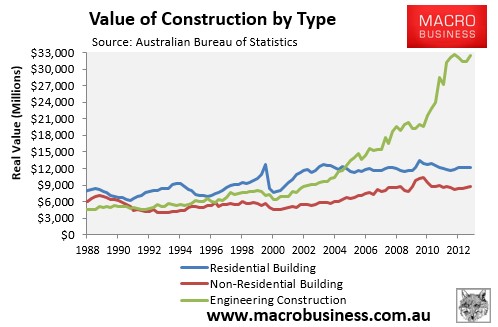
Given the large relative size of mining investment (represented below as engineering construction), there is next to no chance that the nascent lift in dwelling construction will be able to fill the void left as the mining investment boom unwinds (see next chart).