
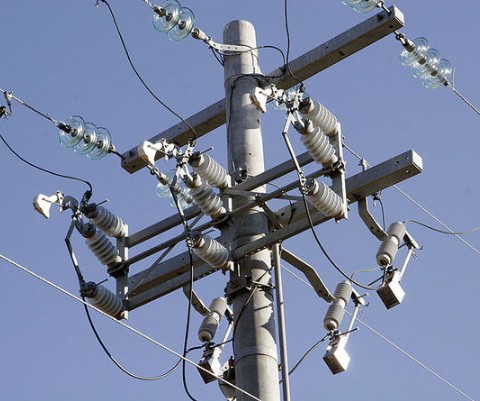
The Guardian has published an interesting report on why Australia’s electricity pricing system is both unfair and unsustainable, citing particular concern how the expansive network of “poles and wires” – required to ensure “peak load” (uninterrupted power supply during massive short-term spikes in demand) is spread evenly across all users, rather than paid more by those using the most power during peak periods. Network costs comprise nearly 50% of average household power bills:
Research by the Centre for Policy Development released late last year concluded that the 30% of Australians without air conditioners are subsidising the cost of the electricity network needed only to supply power to those with air conditioners by at least $250 a year. A similar study by the Productivity Commission, which also took into account the cost of generating the power, put the effective subsidy at $350 a year…
“The current system is unfair,” he says, likening it to building a multi-lane highway across the Sydney Harbour bridge so there were never traffic jams even at peak hour but charging everyone, whether they used it or not…
According to the Energy Supply Association of Australia (ESAA), 73% of Australian homes had an air conditioner in 2011 compared with 35% in 1999. The Committee for Economic Development of Australia found that air conditioners bought for $1,500 frequently imposed a $7,000 cost on the energy system.
The inequitable increase in electricity costs has been exacerbated by the huge uptake of rooftop solar panels, the ESAA and the Grattan Institute argue, because solar households avoid the high network charges levied evenly across units of power used, but actually demand power from the grid just as much during those peak times which contribute most to the costs of the network.
“Households with solar end up paying less for the network because they generate some of their own electricity and import less from the grid…
“Most solar households end up only paying a fraction of their fair share of the cost of maintaining the network. They’re not doing it deliberately, it’s just the way the billing arrangements for electricity were set up, long before rooftop solar reached the scale we see today.”
The ESAA and the Grattan Institute say that if the government does nothing, power bills could rise even further as the market enters a “death spiral” – where fewer customers are forced to pay the high fixed costs of the electricity network, encouraging even more customers to turn to rooftop solar to reduce their bills, increasing still further the inequity in the electricity billing system…
“The ‘death spiral’ is a term used to describe the situation where declining demand, technology changes and rising prices may interact in a way that induces large numbers of consumers to disconnect from the network. In that case the whole funding model of Australia’s regulated power networks is under threat … and falling demand keeps pushing up power prices.
Similar concerns were raised recently by Professor Stephen King from Monash University, who argued that declining residential power demand – caused in part by an increased take-up of solar panels – is leading to higher prices to cover fixed costs (the dreaded ‘death spiral’). King also claims that the problem has come about because of policy that has turned fixed costs into variable charge, leading to nasty outcomes:
When consumers install PV [solar] systems, their demand for traditional electricity falls. These consumers reduce the amount they ‘use’ the network. But the fixed network costs do not change. So these fixed costs are spread over a smaller volume of electricity. And this means that the price of that electricity has to rise for everyone else.
Of course the rise in price encourages more consumers to adopt power-saving technologies and to install PV systems. So these consumers also reduce their consumption of traditional power. But the network costs are still fixed. So the price of electricity has to rise for everyone else.
And so on…
More likely, it will lead to a group of haves and have-nots. The well-off, who can afford to install PV systems and buy power saving appliances will avoid much of the high power prices. Those who cannot afford solar systems and new energy efficient appliances will pay a high electricity price.
The Grattan Institute claims that the solution lies in implementing some form of differentiated pricing, whereby the portion of an electricity bill earmarked to pay for network costs is no longer levied uniformly per unit of power used, but rather increased for those who use more power at times of peak demand, such as homes with multiple air conditioners.
By comparison, Professor King argues that network charges should be turned back into fixed charges that can only be avoided by disconnecting from the electricity grid. Installing a solar system would, therefore, not reduce one’s network charges, only their power charges. As a result, the have-nots will not have to pay higher network charges because the haves cannot avoid those charges.
Whatever the case, the electricity pricing system looks in dire need of reform.
unconventionaleconomist@hotmail.com
