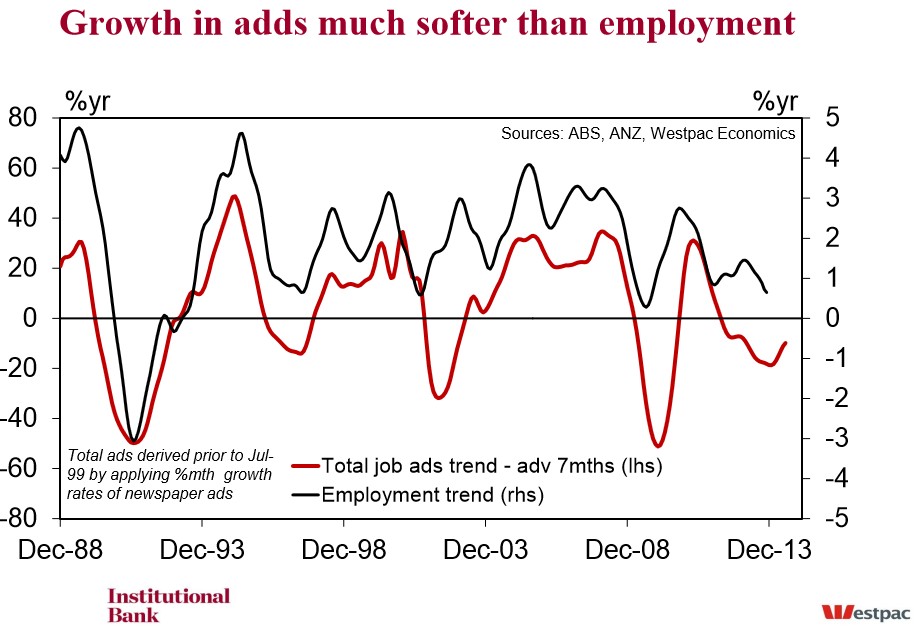
Job advertisements fell a further 0.7% in Dec, following a 0.9% fall in Nov and a relatively flat print in Oct (–0.1%). We have now seen just two positive prints from job ads in the last 22 months leaving ads some 25% lower than in Feb 2012.
However, the pace of decline has slowed as job ads are now 9.1% below year-ago levels, an improvement from –10.3%yr in Nov and –18.8%yr in Jun 2013.
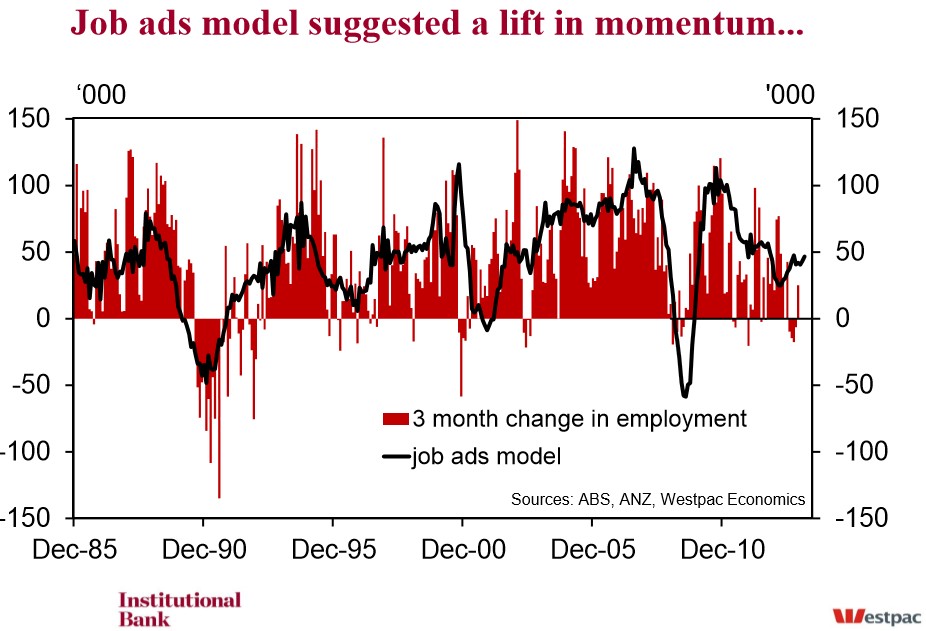
This moderation in the rate of decline also appears in our model of the 3-month change in employment as a more robust outlook for employment. However, as you can see in charts 6 & 7 there have been large deviations from the model estimates and actual employment outcomes.
Internet job advertisements fell 0.7% in Dec to be down 8.3%yr.
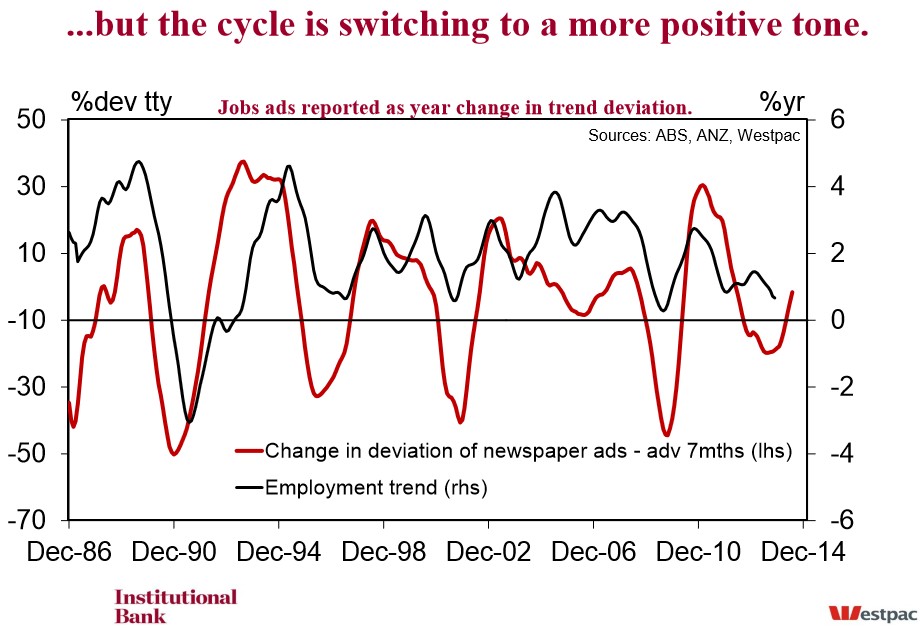
Newspaper ads rose 0.4% in Dec leading to a sharp uptick in the annual change in the deviation from trend of newspaper ads (chart 9). This second derivative of newspaper ads abstracts from the trend decline in this series and has been a handy indicator of turning points. This signal is getting more positive.
As Westpac has noted before, there clearly are issues with the ANZ jobs ads series and how they compose the internet series in particular. We thus use job ads very cautiously as a leading indicator of employment. Nevertheless, it is providing a sign of a turnaround in labour demand which is something to watch closely.
Labour demand in NSW has been trending modestly higher according job ads. Job ads in WA have improved in trend terms, following some significant weakness over the past two years or so as mining activity moderated. Job advertising trends for Vic have been mixed but the rate of deterioration in advertising has slowed. Other non-mining states are also showing signs of some stabilisation in job advertising overall.
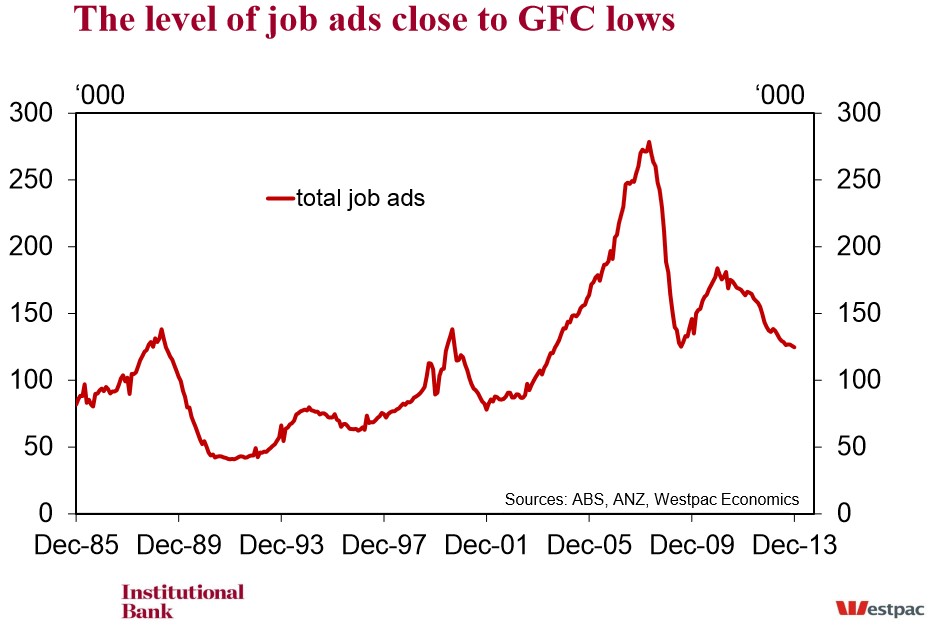
Job ads index continues to highlight that the level of labour demand is still well below the highs of 2008; it is just 0.4% higher than the post GFC low. Firms still appear to be quite reluctant to hire in a meaningful way.
We will be closely job ads over the coming months to see if the early signs of an improvement continue into 2014.
Leith van Onselen is Chief Economist at the MB Fund and MB Super. He is also a co-founder of MacroBusiness.
Leith has previously worked at the Australian Treasury, Victorian Treasury and Goldman Sachs.