Delloitte Access Economics’ quarterly review of the Australian economic outlook has issued a dire warning about Federal Government finances, forecasting that $25 billion of expenditure cuts will be required if the Budget is to return to surplus. From The Australian:
“At around $25bn a year, the new federal government doesn’t have a mandate for the scale of cuts required to return the budget to health and the opposition (like the current government before it) is already succumbing to the temptation to oppose even sensible savings,” the report says…
Deloitte Access Economics partner Chris Richardson said there was a risk the audit commission’s recommendations would result in only some trimming to the growth of spending, not the absolute reduction that was required…
Mr Richardson said that while spending cuts should bear the major burden of improving the budget, raising taxes could not be put out of bounds. He said there was a danger that the task of budget repair would focus on measures that lost the least votes, rather than on what was best for the nation.
He said the continuing deficits were symptomatic of a country living beyond its means, and reflected the permanent spending commitments financed out of a temporary commodity bonanza…
[The report] foreshadows two difficult years ahead with the end of the resource project construction boom leaving another 50,000 people unemployed, while real living standards have already started to decline.
The fact of the matter is that Australia’s revenue base is shrinking, as the large baby boomer cohort shifts into retirement and the share of workers supporting non-workers declines. At the same time, the ageing of Australia’s population and the growing proportion of retirees will increase the amount of health and aged-care expenditure, significantly increasing overall Budget outlays.
Added to these demographic headwinds is the ongoing unwinding of Australia’s terms-of-trade from 140-year highs, along with headwinds in the form of declining mining-related capital expenditures, which will detract from Australia’s income/GDP growth and employment, again placing pressure on government budgets via lower personal and company tax receipts and GST, as well higher welfare payments.
Advertisement
That said, Chris Richardson is correct to suggest that expenditure cuts alone won’t be enough to restore the Budget to health, with increases in taxes also required.
As highlighted by economist Matt Cowgill late last year:
In the terms of reference for the Commission of Audit, the Government said that “the size of the Commonwealth Government has expanded significantly” in the past 20 years. This isn’t true if you measure the size of government by its revenue or spending as a share of the economy…
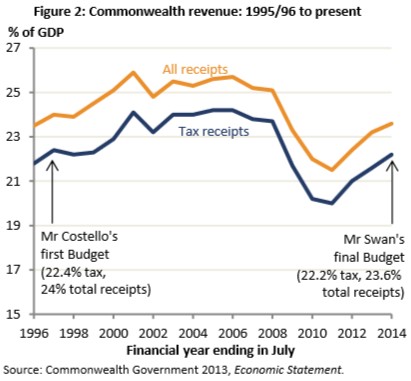
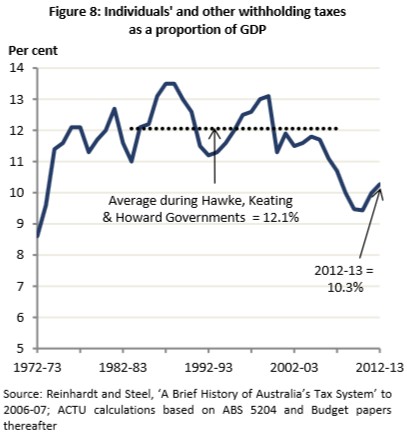
…to the extent that tighter fiscal policy is desired, this should be achieved through restoring tax receipts, not by reducing expenditure. The primary cause of our structural deficits is a fall in revenue (as a proportion of GDP). Reversing this revenue shortfall should be the focus of any attempt to close the structural budget gap. An adequate revenue base is needed to ensure that Australian governments can provide the quantity and quality of public services that citizens demand.
The Parliamentary Budget Office recent estimated that between 2002-03 and 2011-12, “the structural level of [Commonwealth] receipts fell by around 5 percentage points of GDP” while the structural level of payments (excluding GST) rose by around 1 percentage point of GDP. The bulk of the deterioration in the structural budget balance has therefore come about because of a decline in revenues, not an increase in expenditure. Of that decline in revenues, the PBO estimates that “over two thirds… was due to the cumulative effect of the successive personal income tax cuts granted between 2003-04 and 2008-09”…
Advertisement
I broadly agree with Cowgill’s assessment. Australia’s Budget is suffering to a large extent from a revenue problem, which will only get much worse as Australia’s population ages and proportion of workers supporting non-workers shrinks. Accordingly, any meaningful fix will require increased taxes, not just cuts to spending, although these too will be required.
I also believe that Australia’s system of government could be made much more efficient. There is too much overlap between government departments (both state and federal) and, in my opinion – having worked in both the Australian and Victorian treasuries – too many back office bureaucrats. The bureaucracy should, therefore, be consolidated, which would assist in returning the Budget back to balance.
Leith van Onselen is Chief Economist at the MB Fund and MB Super. He is also a co-founder of MacroBusiness.
Leith has previously worked at the Australian Treasury, Victorian Treasury and Goldman Sachs.