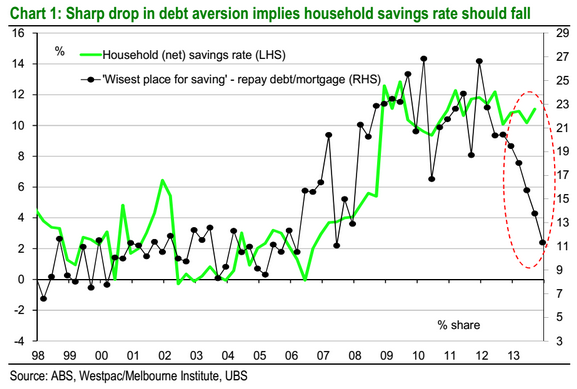
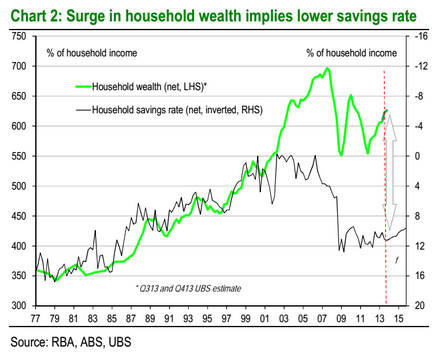
In our final weekly (AEP) for 2013, we highlight the household savings rate jumped in Q313 to 11.1%, the highest since Q212 – & far above the pre-GFC trend closer to 0%. However, looking forward we expect the savings rate to fall solidly (down by a cumulative 1½%pts by end-2015), driving real consumption growth to pick up from a soft 1.8% y/y in Q3, to a stronger ~3% y/y in both 2014 and 2015.
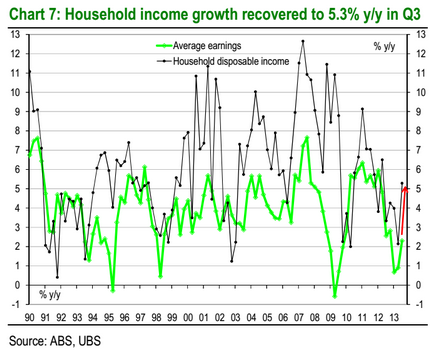
Supporting our view of a lower savings rate and faster consumption growth is that rising household wealth should be sustained for long enough to finally ‘spill-over’ to a lower savings rate (i.e. wealth effects). This is evident by a survey of household attitudes – towards the wisest place for savings – showing a sharp drop in those wanting to repay debt/mortgage to the lowest share since 2007, while consumer sentiment is also holding around average. Indeed, a positive is a recent improvement in income growth, up a decent 5.3% y/y in Q313 (boosted by ¾%pt y/y due to sharp RBA rate cuts that slashed interest payments to a decade low of 9% of income), and tentative signs of stabilisation in the labour market.
Overall, a solid fall in the savings rate, coupled by low inflation (amid likely ongoing strong population growth), means real consumption growth can pick-up as we expect to ~3%, even without an acceleration in household disposable income growth (albeit wages and jobs growth still needs to improve a bit ahead, given the likely end of the direct boost from RBA rate cuts that lowered interest payments).
The risk case to our view remains if the savings rate fails to fall because it remains ‘de-coupled’ from its prior historical relationship to wealth, confidence and attitudes to saving.
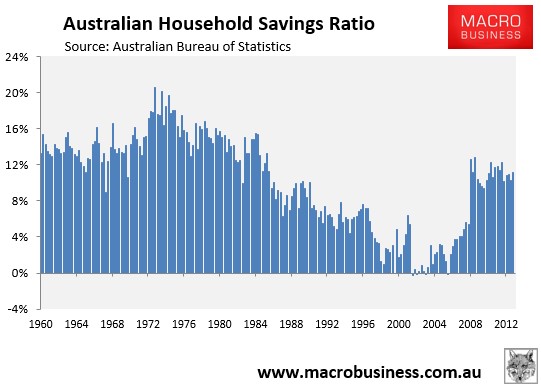
I would reverse the UBS conclusion. The falling away of risk aversion is not the same as reducing savings. It is a shift in the chosen vehicle for saving. The national accounts measure of household savings has been rock solid since 2008:
The base case aught to be that this does not change. It is structural. That it might fall and consumption rise is an upside growth risk not the base case. I expect to see a modest improvement in consumption next year on the factors cited but the cycle will not dent the savings impulse in my view.
David Llewellyn-Smith is Chief Strategist at the MB Fund and MB Super. David is the founding publisher and editor of MacroBusiness and was the founding publisher and global economy editor of The Diplomat, the Asia Pacific's leading geo-politics and economics portal.
He is also a former gold trader and economic commentator at The Sydney Morning Herald, The Age, the ABC and Business Spectator. He is the co-author of The Great Crash of 2008 with Ross Garnaut and was the editor of the second Garnaut Climate Change Review.