
Given today’s weak stock market, I thought I might speculate a little on why the local market appears to be decoupling from Wall St. The bourse is on track for its worst December since its inception in 2000 and has been increasingly under-performing Wall St since late 2011:
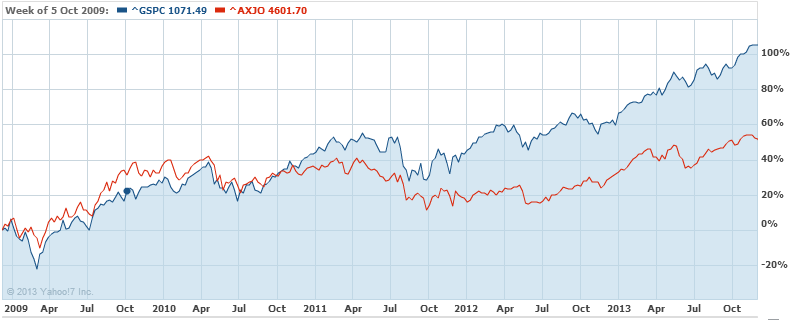
The early divergence coincides with two peaks in the post-GFC environment. The first was the pivot for Chinese growth when the great stimulus began to wane and growth to slow. Second and following on, it was the peak in Australia’s terms of trade.
The notion that Australian stock market returns are now being held back by its connection with Chinese growth is born out by a glance at wider bourses. The following chart shows a range of global markets for 2013:
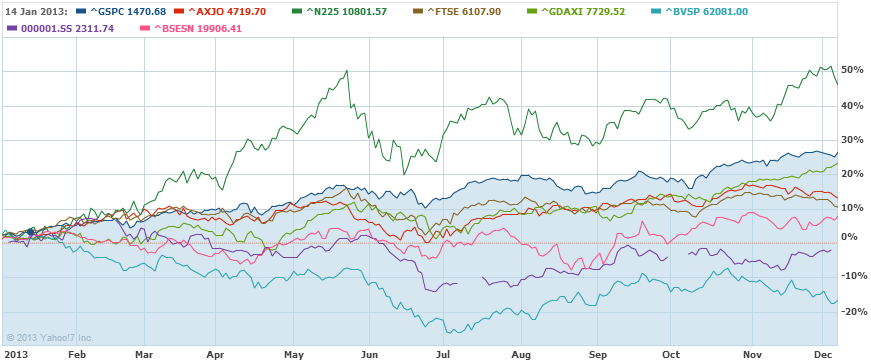
As you can see, the ASX200 is mid pack, well behind Japanese, North American and German returns. But well ahead of emerging markets like India and Brazil and China.
This is itself, I think, a reflection of Australia’s very peculiar economic makeup. Most nations have a balance of what I describe as pre-modern, modern and post-modern growth drivers, that is primary goods, value-added manufactures, and services. Some other nations have concentrations in two of these three. Japan for instance has little of the first but plenty in the other two. But Australia is quite unusual in being dominated by pre-modern and post-modern production.
So far in this cycle this is working to smooth stock market returns as global growth is shifting from developing to developed countries and in Australia from pre-modern commodities to post-modern services. That we miss the intervening step doesn’t matter so long as the transition is smooth globally. Banks and consumer stocks are rising as mining and associated industries get a caning.
The problem for us will come if the pre-modern stuff slows more quickly than the post-modern can get moving which is my base case for the next few years. Then our under-performance versus Wall St will become extreme.
It’s interesting to note that after a decade of granting exceptional returns to pre-modern dominated stock markets, the returns are now ramping up in the post-modern. Here’s the ASX200 versus the S&P500 from 2002:
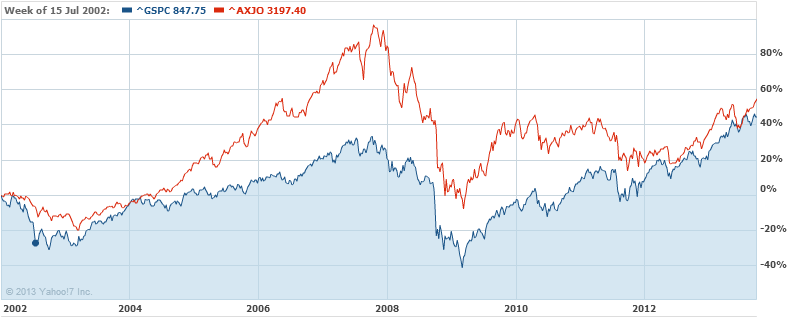
After favouring Australia spectacularly for much of the time (ex-dividend), returns have now evened out. I’d expect the post-modern to continue to out-perform, before its crash.
