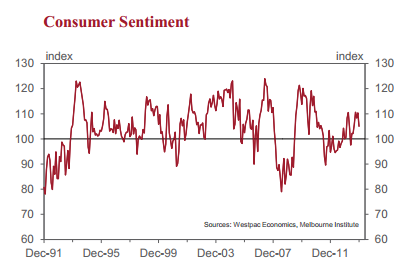
Westpac Consumer Sentiment is out and the honeymoon is well and truly over:
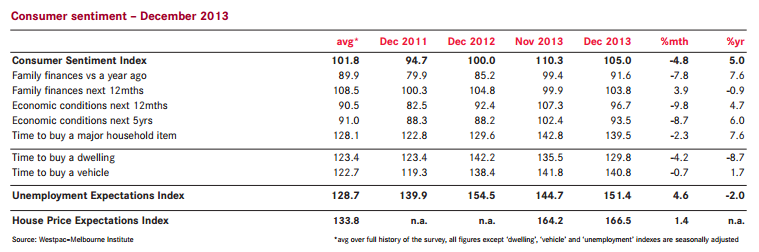
This is the lowest level of the Index since July this year. It is 4.3% below the average print for the last 3 months which covered the post-election period and the time of most euphoria around house prices. It appears that the boost in Confidence partly associated with the election result and booming house prices has faded in December.
In particular, confidence around the economic outlook has faltered. The components of the Index measuring consumer views on the economic outlook over the next 12 months and 5 years are both down by over 10% from their average reads over the last 3 months.
The news is no better around the labour market. More consumers expect unemployment to rise with the Westpac Melbourne Institute Unemployment Expectations Index increasing by 4.6% from 144.7 to 151.4. This measure provides an indication of how secure respondents feel in their jobs. The Index is 5.4% above the average read of the last 3 months and remains 6.3% above its level in October 2011 despite 225bps in rate cuts by the RBA. That compares to the Consumer Confidence Index which is 8% above its October 2011 level.
Four of the five components of the Consumer Sentiment Index were down in December. As discussed, the two economic outlook components were down very sharply – the sub-indexes tracking consumer views on the 12 month outlook down 9.8%; and the 5 year outlook down 8.7%. The results around family finances were more mixed – the sub-index tracking assessments of ‘family finances compared to a year ago’ down 7.8% but the sub-index tracking expectations for ‘family finances over the next 12 months’ up 3.9%. That latter result may partly reflect a recovery from a steep 7.4% fall in this component in November with the sub-index still 7.4% below its average level in the 3 months to October.
There was also a 2.3% fall in the component tracking views on whether ‘now is a good time to buy a major household item’. In December, we also receive information on respondents’ most widely recalled news items. The highest recall this month was on items about economic conditions; budget and taxation; interest rates and employment. Relative to September, when we last surveyed consumers’ news recall, respondents assessed news to be significantly more unfavourable around employment; budget and taxation; and interest rates. It is likely that news on job losses in high profile companies such as Qantas and Holden may have unnerved respondents while media coverage of rising fixed mortgage rates may also have been a factor in the sharp swing in assessments of interest rate news from favourable to unfavourable.
The news around the housing market is mixed and is probably pointing to an affordability constraint impacting the market. The index tracking responses to the question on whether now is a good ‘time to buy a dwelling’ fell by 4.2% in December to be down by 10.5% from its September peak. At the same time, the Westpac Melbourne Institute House Price Expectations Index increased by 1.4% to be up by 14% over the last 5 months. The mix suggests an affordability issue and is most apparent in New South Wales where prices have increased the fastest – the index tracking NSW responses to ‘time to buy a dwelling’ plummeted 13% in December to be down 21.9% from its September peak, while the state measure of house price expectations is 6.1% higher than the national reading.
There was no clear message around respondents’ savings preferences in the December survey. On the one hand we saw a move toward more risk. The proportion of respondents who favoured equities as the wisest place for savings increased by 2.8ppts to 11.6% – the highest proportion since March 2011. There was also a much less conservative attitude toward debt: the proportion of respondents nominating ‘pay down debt’ as the preferred option fell by 2.4ppts to 11.3%, down from 26.6% in December 2011 and the lowest reading since June 2007.
On the other hand there was an increase in the proportion of respondents favouring bank deposits from 29.3% in September to 32.6% in December. The proportion favouring real estate fell from 27.5% to 26.6% while those nominating ‘spend it’ fell from 5.3% to 3.0%.
However if we take a longer perspective on this issue there is a clear preference shift back toward less conservative financial attitudes. Over the last 2 years the proportion of respondents favouring ‘pay down debt’ has fallen by 15.3ppts from 26.6% to 11.3%. That corresponds with increases in those favouring real estate (12.6ppts); equities (5ppts); bank deposits (2.5ppts). Other balancing items include non-bank deposits (–3.5pp’s) and spend it (–3ppts).
The Reserve Bank board does not meet again until February 4. There are some significant messages in this survey for the Board to ponder over the Christmas break. Firstly it is clear that Australians are nervous around their jobs. Despite a significant boost to economic confidence immediately follow the election, respondents remained unsettled about job security. The December survey has revealed a distinct fall in confidence around the economy and a further deterioration around job security.
Meanwhile the message around the housing market is that while prices are rising and are expected to continue to rise, households are becoming more reluctant to enter markets that they may perceive to be unaffordable, particularly given their concerns around job security. Investor interest in housing also seems to have waned somewhat with increased interest now focussed on equity markets.
Despite recent meeting minutes showing regular discussions around further policy easing, it seems that concerns about overheating the housing market will remain a constraint on Bank policy. However, the messages from this survey are that a potential drop-off in housing demand due to affordability issues might slow the current surge in prices, while the other issues around the labour market are unlikely to disappear. Evidence from employment intentions in some separate business surveys support this expectation. Based on the Bank’s below vtrend growth forecasts there seems to be a case for easier policy although, at this stage, the Bank clearly prefers to encourage a lower Australian dollar through ‘jaw boning’ rather than cutting rates. Whether such a policy will be successful is highly uncertain given its reliance on the policies of other central banks, particularly the Federal Reserve and the Bank of Japan.
Westpac has maintained a forecast for another rate cut of 25bps at that February meeting for some time. It may be that the interaction of forces which we envisage takes longer to become apparent to the Board and the rate cut decision is delayed for some months. Of particular concern here is whether the housing data over the next few months is sufficiently reliable. For now, we retain our call for a cut in February while fully recognising that a delay to that move is also a realistic outcome.
David Llewellyn-Smith is Chief Strategist at the MB Fund and MB Super. David is the founding publisher and editor of MacroBusiness and was the founding publisher and global economy editor of The Diplomat, the Asia Pacific's leading geo-politics and economics portal.
He is also a former gold trader and economic commentator at The Sydney Morning Herald, The Age, the ABC and Business Spectator. He is the co-author of The Great Crash of 2008 with Ross Garnaut and was the editor of the second Garnaut Climate Change Review.