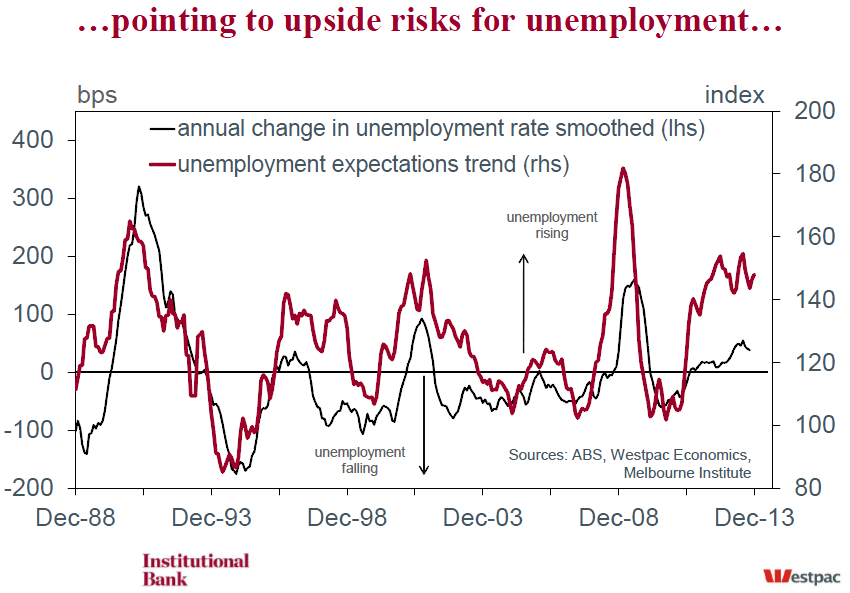
More from Westpac’s range of consumer surveys today. Unemployment expectations have rebounded:
The unemployment expectations index rose 4.6% in Dec following on from 0.9% rise in Nov and a 0.6% rise in Oct. The index is now just 4.5% lower than where it was in Jun which had been looking like being a cyclical peak. The index has deteriorated since Sep (a fall in the index suggests consumers are not expecting unemployment to rise as much as they were) rising 6.2%.
This lift in the index has seen a turnaround in the annual pace from –8.2% in Sep to –2.0% in Dec. Unemployment expectations are decidedly less upbeat than they were just three months ago.
The trend series also highlights that whereas the index was looking as if it has peaked a few months ago it is now deteriorating again. The trend index, which the MI reports as a three month centred average, was –1.8%mth Oct, 2.0%mth in Nov and 1.0% in Dec.
Clearly, as 2013 end household are starting to get nervous about jobs again. The recent press on Holden & Qantas would not have helped.
In addition, the index trend is 17% higher that it long-run average. This suggests that employment growth continues to underperforming relative to population growth and as such, the employment to population ratio is likely to hold at GFC lows. .
All occupations are getting more nervous but managers & professional are still the most worried. Interestingly, households without children are the more worried than those that don’t.
Sydney is the most worried city, Melbourne the least, but the remaining cities are becoming more worried as unemployment expectation bounce in the mining powerhouse of WA. In fact, WA household are now relatively more worried than Qld and Vic. Surprisingly, Vic has the strongest level of unemployment expectations relative to its long run average but they are rising there as well.
In NSW, hours worked has outperformed the unemployment expectations index while full-time employment has underperformed. In that state, employers are clearly working their existing employees harder than employing new workers.
Vic is seeing full-time job leap ahead of unemployment expectations where lagging hours worked appears to be more of a factor.
Qld is not as extreme but also highlight stronger hours worked relative to a modestly positive outcome for full-time employment.
In WA, the recent lift in full-time employment is turning over and unemployment expectations are more closely aligned with the softer hours worked numbers.
David Llewellyn-Smith is Chief Strategist at the MB Fund and MB Super. David is the founding publisher and editor of MacroBusiness and was the founding publisher and global economy editor of The Diplomat, the Asia Pacific's leading geo-politics and economics portal.
He is also a former gold trader and economic commentator at The Sydney Morning Herald, The Age, the ABC and Business Spectator. He is the co-author of The Great Crash of 2008 with Ross Garnaut and was the editor of the second Garnaut Climate Change Review.