The consumer pulse taken by Westpac below. It’s a spectacular survey and very much accords with my own view of the year ahead. Households are loosening modestly on spending, are prepared to invest in risk assets but not at the expensive of saving, and are slowly responding to the falling dollar. A not discouraging survey. Full report here.
–Melbourne Institute Index of Consumer Sentiment fell 4.8% from 110.3 in Nov to 105.0 in Dec.
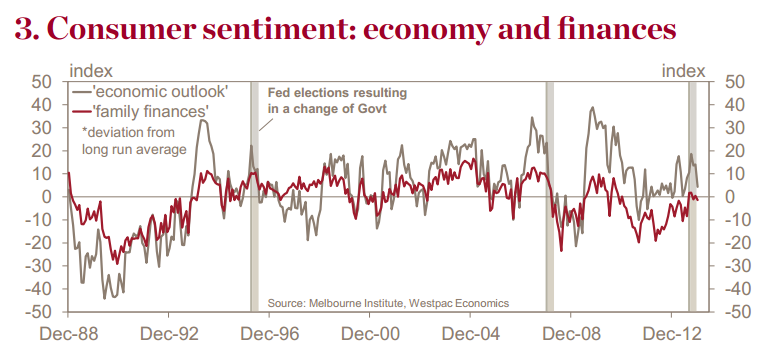
― The sentiment boost from the election apparent in Sep-Nov has clearly faded with consumer confidence around the economy faltering. Consumers would also have been unnerved by news of job losses at Qantas and Holden.
― Additional questions on news recall show news on ‘economic conditions’; ‘budget & tax’; ‘interest rates’ and ‘employment’ dominated with most items assessed as unfavourable including significant deteriorations vs Sep in most cases.
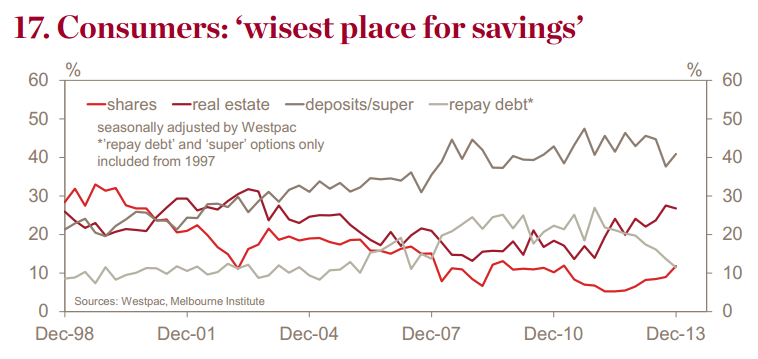
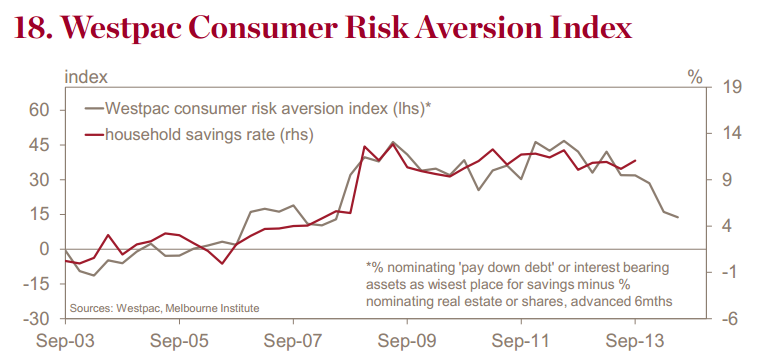
― Updates on the ‘wisest place for savings’ question show a further modest decline in those nominating safe options toward riskier ones albeit with ‘equities’ finding more favour. The mix resulted in a further 2.4pt decline in the Westpac Risk Aversion Index – our measure that combined these responses into a single gauge of risk aversion. The Index continues to point to a signifi cant easing in risk aversion since the middle of the year.
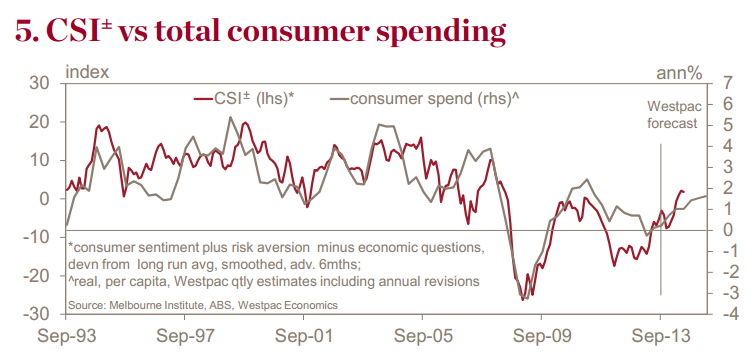
― More generally, the survey detail continues to point to a pick up in spending momentum heading into 2014. Our CSI± measure, which we favour as a guide to actual spending, recorded a milder 1.5% fall in Dec but continues to point to a pick up in spending growth to over 3%yr.
― The indexes tracking consumer views on ‘time to buy a major item’ and ‘time to buy a vehicle’ also recorded milder declines in Dec (–2.3% and –0.7% respectively) and remain well above long run averages. Note that the ‘time to buy a vehicle’ sub-index will be discontinued in 2014. Research indicates that the ‘time to buy a major item’ sub-index provides a good proxy for this measure.
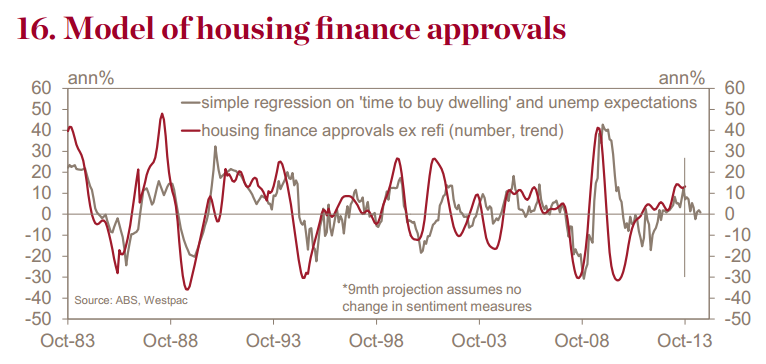
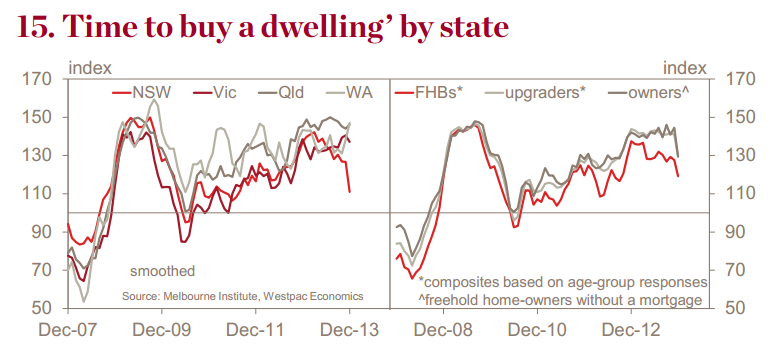
― The index tracking views on ‘time to buy a dwelling’ fell 4.2% in Dec. Although it remains at a high level the 10.5% decline from the Sep peak suggests a sustained shift is underway. The decline was heavily concentrated in NSW
where recent dwelling price growth has been particularly strong, suggesting that there is an aff ordability issue emerging. Consumers expect prices to continue rising with the Westpac Melbourne Institute House Price Expectations Index rising a further 1.4% in Dec to a new cycle high.
― The heightened job anxiety that has haunted consumers for most of the past 2yrs returned in Dec. The Westpac Melbourne Institute Unemployment Expectations Index rose 4.6% in the month, having now retraced over half of the decline between Jun and Sep. Higher readings mean more consumers expect unemployment to rise in the year ahead, a factor that will continue to weigh on consumer decisions around spending and borrowing.
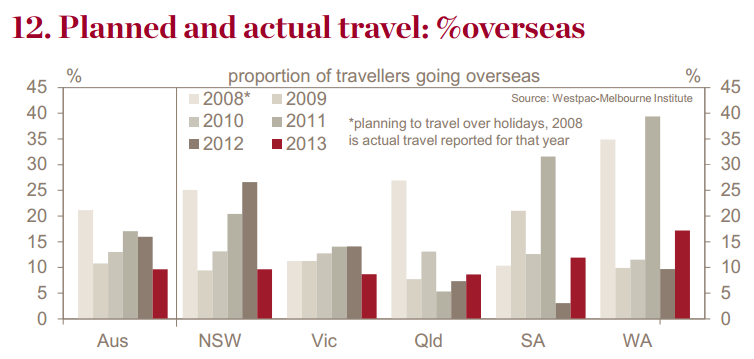
― The Dec survey also included extra questions on holiday travel plans. The results show just under a third of households expect to travel this year, down slightly on the 34.4% last year but above the low of 30.8% in 2011. State variations were significant although all showed a notable shift away from travelling abroad towards travelling
domestically.
David Llewellyn-Smith is Chief Strategist at the MB Fund and MB Super. David is the founding publisher and editor of MacroBusiness and was the founding publisher and global economy editor of The Diplomat, the Asia Pacific's leading geo-politics and economics portal.
He is also a former gold trader and economic commentator at The Sydney Morning Herald, The Age, the ABC and Business Spectator. He is the co-author of The Great Crash of 2008 with Ross Garnaut and was the editor of the second Garnaut Climate Change Review.