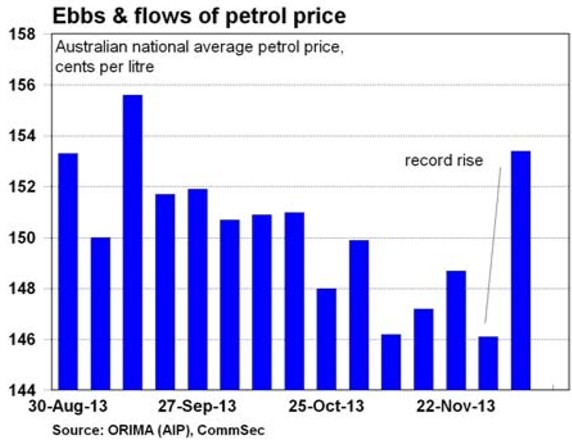
According to the Australian Institute of Petroleum, the national average Australian price of unleaded petrol rose by a record 7.3 cents per litre to a 12-week high of 153.4 cents a litre in the week to December 8. The increase reflects the end of discounting cycles in large capital cities. But the wholesale (terminal gate) price also stands at a 12-week high, pointing to even higher pump prices ahead…
Today, the national average wholesale (terminal gate) unleaded petrol price stands at 142.4 c/l, up 1.1c over the week and up almost 8 cents from the five-month low set on October 31.
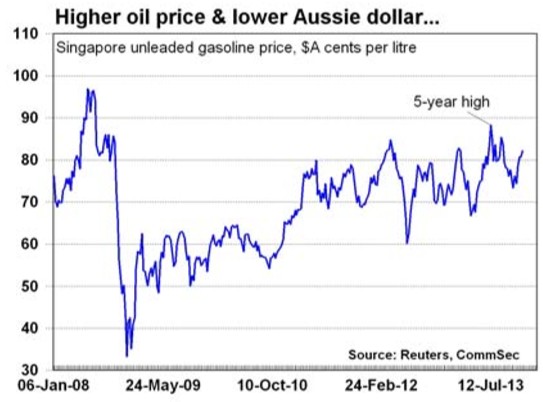
Last week the key Singapore unleaded petrol price rose by US$1.70 (1.5 per cent) to a 13-week high of US$118.30 a barrel. And in Australian dollar terms the Singapore gasoline price rose by $2.29 (1.8 per cent) last week to a 13-week high of $130.60 a barrel or 82.14 cents a litre…
Probably the best guide at present to the ‘true’ or ‘underlying’ Australian petrol price is the Perth market, which follows a set weekly cycle. The average Perth petrol price rose by 1.8 cents a litre last week in response to a similar lift in the wholesale price in the previous week.
In Sydney, Melbourne, Brisbane and Adelaide, unleaded petrol prices peaked over last Tuesday and Wednesday and have since fallen by between 3-7 cents a litre. So the Australian average petrol price will likely ease over the week. In an underlying sense though, higher world oil prices and a weaker Aussie dollar have conspired to lift the wholesale price to a 12-week high of over 142 cents a litre. This should be seen as close to a “floor” price. Certainly motorists should see it as an attractive proposition if they are able to fill up below 142 cents a litre.
The volatility of petrol prices is hardly positive for consumer spending in the lead up to Christmas.
Leith van Onselen is Chief Economist at the MB Fund and MB Super. He is also a co-founder of MacroBusiness.
Leith has previously worked at the Australian Treasury, Victorian Treasury and Goldman Sachs.