
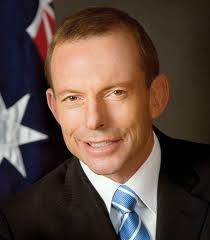
This is better from the PM. From the AFR:
Prime Minister Tony Abbott has forecast a bounce in economic growth emanating from his promised review of competition policy as he reassured the business community he had not dropped the ball on economic reform.
…In a speech on Wednesday night to the Business Council of Australia, Mr Abbott said the competition review which will, as part of its remit, take aim at the market dominance of supermarket giants Coles and Woolworths, would be the biggest such inquiry into competition since the Hilmer inquiry two decades ago.
The reforms which came from that inquiry added an estimated 2.5 per cent to Australia’s gross domestic product, the Prime Minister said, as he announced the terms of reference for his inquiry had been sent to the states for approval.
“The new review is designed to ensure that businesses big and small are competing on a genuinely level playing field because fierce but fair competition will give every business the best chance to succeed and give every customer the best chance of the best price,’’ he said.
This is probably the most important reform agenda Abbott could introduce; competition policy with teeth that aimed to break up or push back the cartels that dominate most sectors of the Australian economy. It could have enormous benefits if it unstopped productivity.
Sadly, I doubt this will lead anywhere. Liberal insiders Andrew Robb and Maurice Newman have already confessed their admiration of oligopolies and it’s a very difficult issue for a politician to address. But it makes sense, should be pursued with vigour and kudos to Abbott for bringing it on.
According to The Australian, the PM went further and announced a business advisory council:
The Prime Minister’s business advisory committee will include former Productivity Commission chairman Gary Banks, National Australia Bank chairman Michael Chaney, Linfox executive chairman Peter Fox, Grocon chief executive Daniel Grollo, retailer Solomon Lew, BHP Billiton chairman Jacques Nasser and Telstra chairwoman Catherine Livingstone.
And he said:
…”The coming white paper on the federation will inform the mandate for less overlap and duplication that the government will seek at the next election,” Mr Abbott said.
Again, this is also potentially very good for productivity. Economists call the mismatch between state and Federal responsibilities and revenue raising tools “vertical fiscal imbalance”. It leads to all kinds of perversions and inefficiencies within the Federation, everything from “horizontal fiscal equalisation” whackyness that punishes successful and rewards parasitic ones, to an over reliance on highly distorting taxes like property stamp duties. Clarifying and simplifying this system with his range of Liberal governed states in support would be a generational contribution by the Abbott Government to our standards of living. It is potentially a regime defining mission.
Finally the PM said:
… tax reform would start with abolishing the carbon tax and the mining tax but the coming tax reform white paper would “inform the mandate for lower, simpler, fairer taxes that the government will seek at the next election”.
Abolishing the carbon and mining taxes is tax un-reform. But seeking a better taxation regime is again potentially a valuable productivity exercise if it improves efficiency. Measures like abolishing negative gearing, installing land tax, etc could be very useful.
In summary, these three committed reviews potentially represent a powerful productivity reform agenda.
Thus, one wonders why the Prime Minister isn’t saying so. This goes way beyond being “open for business”. It’s part of Australia’s post-boom economic adjustment and about our future prosperity. “Open for business” is a pitch to a narrow interest group.
The PM needs is a bigger narrative. He needs to tell the story of why Australia needs such productivity reform. “Open for business” is an opposition slogan that implicitly references the business community’s dislike of previous Labor governments. That’s fine but it constrains Abbott from selling his message more broadly and prevents him from rallying the polity, most of whom are employees not businesses, to the productivity mission.
This will leave him vulnerable when businesses turns on him. And turn they will if he is serious. If done right, this agenda will be a red rag to every rentier in the country. Affected interests will all twist “open for business” to their advantage and scream “closed”.
Abbott needs to be pitching this story to the entire nation. “Open for business” is bad for business.
