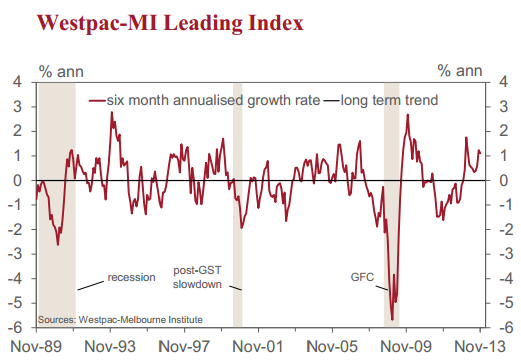
Bill Evans is doing his bets to sell his rejigged index but it continues ot signal a boom against his own wider analysis:
The growth rate in the Leading Index has been above trend for the last 12 months. That followed an 18 month period where growth was below trend and was clearly signalling the soft growth which the economy experienced in the year to the June quarter where GDP growth registered a disappointing 2.4%. Recent above trend growth in the Index is pointing to an above trend outcome over the next few quarters.
This is the second month where we have reported the New Leading Index.
This Index represents a significant restructure of the Leading Index following an exhaustive review which was conducted in 2012 and 2013. The new Index includes only monthly series which are not subject to the material revision which the quarterly series in the original Index experienced. Furthermore, the components of the Index are available on a more timely basis, allowing us to report the Index with only a one month lag rather than the two months for the original Index. Our exhaustive historical analysis of both Indices indicates that the new Index islikely to detect turning points in the cycle earlier than the original Index. A detailed analysis of the new Index and comparison with the performance of the original Index was released on November 19 and is attached to this press release.
Westpac is expecting growth over the year to June 2014 of 2.4% while the Reserve Bank recently released its own growth forecasts to June at 2.5%.Both forecasts take into account a significant drag from the downturn in mining investment. It is not clear how this large supply side effect can be captured in a Leading Index. As such we should interpret the signal from the Leading Index as pointing to a solid lift in the growth momentum of the non mining sector. That is a significant observation and one that will give the authorities some encouragement that their plans to rebalance growth to accommodate the slowdown in mining are paying dividends.
Although the new Leading Index will not capture a large supply side shock from the mining sector its components cover such forces in the economy as: the share market; consumer sentiment; commodity prices; housing; unemployment expectations; the yield curve and hours worked.
As with our analysis of the original Index we disaggregate the main components’ contribution to the change in its growth rate over the last 6 months. Over the last 6 months the 6 month annualised deviation from trend growth pace of the Index lifted 18 December 2013
• The six month annualised deviation from trend growth rate of the Westpac Melbourne Institute Leading Index of Economic Activity which indicates the likely pace of economic activity three to nine months into the future fell to 1.11% in November from 1.24% in October. from 0.48% to 1.11%. Positive contributions to that change came from: US industrial production (0.24 ppt’s); dwelling approvals (0.13 ppt’s); the yield spread (0.22 ppt’s); Westpac–MI Unemployment Expectations Index (0.17 ppt’s); and the ASX (0.13 ppt’s). The RBA Commodity AUD Price Index (–0.11 ppts); the CSI expectations index (–0.08 ppt’s); and hours worked (–0.08 ppt’s) detracted from the growth rate.
Since last month the fall in the “above trend” growth rate was mainly due to a fall in Consumer Sentiment and a slowdown in dwelling approvals. That was partially offset by a lift in US industrial production. In short, over the month, some softness in domestic factors was partly compensated by the improving international environment.
Over the month the level of the Index fell from 98.62 to 98.55. Four components of the Index fell while four increased. The ASX 200 fell by 1.95%, dwelling approvals fell by 1.80%; the CSI (expectations) fell by 5.14%; and hours worked fell by 0.71%. US industrial production rose by 1.12%; commodity prices by 1.47%; the yield spread by 0.15 ppt’s and the Westpac MI unemployment expectations Index by 4.52%.
The Reserve Bank board next meets on February 4. In recent weeks the Bank has switched strategy away from using interest rates to support the economy to promoting a lower dollar. With housing markets lifting, the Bank appears to favour awaiting further developments in housing before reducing rates. That approach is likely to persist through the first half of 2014. We do not expect the next rate cut by the RBA until May next year.
The cyclical turn we’ve seen in data should be triggering a rise in the index but because its monthly it can’t capture quarterly capital expenditure data, which remains quite negative, and so is rising too high.
David Llewellyn-Smith is Chief Strategist at the MB Fund and MB Super. David is the founding publisher and editor of MacroBusiness and was the founding publisher and global economy editor of The Diplomat, the Asia Pacific's leading geo-politics and economics portal.
He is also a former gold trader and economic commentator at The Sydney Morning Herald, The Age, the ABC and Business Spectator. He is the co-author of The Great Crash of 2008 with Ross Garnaut and was the editor of the second Garnaut Climate Change Review.